Pages

Showing posts with label Travel. Show all posts

Monday, September 23, 2013

A Journey Down Nehru-Gandhi Memory Lane


(First published on NewsYaps)

To say that the Gandhi’s are not popular on the Internet would be stating the obvious. Rahul Gandhi is probably the most ridiculed person on Twitter and every few days or so, the pappu tag starts trending as Modi supporters up the ante. His mother doesn’t get off too easily either.  I see material constantly popping up on my Facebook feed which purports to prove that Sonia Gandhi is not an Indian Citizen (or has became one illegally), that she lied about her Cambridge education (a line of attack that is also used on her son), she had KGB links, she has links to Quattrocchi and even posts which, in typical Indian fashion, make fun of the fact that she once held a job as a waitress—a    recent status by stand-up “comic” Rivaldo is: “Rupee crosses 64! Well that's what happens when an Economist takes orders from a Waitress!”

Of course, as the full page ads on Rajiv Gandhi’s birth anniversary show, social media does not elect our rulers. Whether the twitterati like it or not, the Gandhi-Nehru dynasty is a curiously popular political force in the country.

Keeping all of this in mind, on a recent trip to Allahabad, I decided to pop into the Nehru-Gandhi's ancestral residence, Anand Bhawan, just to see where all of this began.

***

My adventure, though, started even before I arrived in the city. Air India uses an ancient ATR 42 propeller aircraft to cover the Delhi-Allahabad route. The plane was literally falling apart: a few of the overhead storage boxes didn’t shut and the seat I got didn’t have the pocket in front for storing books or phones or what have you. While I didn’t complain too much, another lady had a proper row over cockroaches on the flight, one of which, rather dramatically, scurried onto her food while she was eating. Shrug.

Allahabad airport is probably the smallest airport there is and just about as big as your average office. It achieves this by doing away with needless luxuries such as, er... conveyer belts. Charmingly, your luggage is brought to you by attendants on carts. An insipid sign in front of the only office proclaims, “Hindi hain hum, watan hain Hindostan Hamara” proudly declaring that the verse is by “Sir Mohammed Iqbal”. Indian transporters, it seems, have a particular fascination for this line—I’ve seen it painted on railway carriages as well.

The journey from the airport to the hotel was just as eventful, conducted as it was in an auto with an extremely odd mix of religion and sappy romance. The vehicle was plastered with golden 786’s, a large painting of the Buraq, the mythological flying horse of Islam as well as the word aashique bookended with a pair of large, pink bulbous hearts.

Allahabad is precisely the sort of place for which Indian English had to coin the word “mofussil”. Dusty, congested roads, crumbling buildings and a refreshing lack of drainage; yep, Allahabad fits the Hindi-heartland-small-town template to the hilt. In all of this dust, heat and general North Indian small town-ness, though, rise the magnificent Indo-Saracenic spires of Allahabad University. I’ve grown up in Calcutta and lived in Bombay, so when I say that this was the most amazing specimen of the architecture I’ve seen, you know it’s a big deal.  An extremely tall gothic tower next to a huge Islamicate dome flecked with the remains of blue glazed tiles, the grandeur of (the now decrepit) Allahabad University harks back to a past somewhat rosier past than the present for this city.

It was 1877 and Allahabad was sort of a boomtown. The British had just set up a new province, the United Provinces of Agra and Oudh (which corresponds to modern UP) and, with it, made Allahabad its capital.  To practise in this new capital, and its new high court, arrived Nandlal Nehru, elder brother of Motilal Nehru. Academically brilliant, Motilal also set up a roaring practise as a barrister in due course of time.  In 1900, to show off his new found wealth, Motilal bought a veritable mansion in the European quarter of the city and named it Anand Bhavan. Both his son and his granddaughter grew up in this house. In the next half century or so, this house remained the hub of Indian politics given that both Motilal and his son were major Congress politicians. Fittingly, given her role in cementing the role of dynasty in Indian politics, Indira Gandhi turned Anand Bhawan into a museum to the memory of the Nehru-Gandhi’s.

***

Anand Bhawan is an oasis of peace in an otherwise noisy city. Primly manicured lawns house the large blue and white mansion. The structure is surrounded by a verandah which once, no doubt, had khas curtains to cool the Nehrus in the oppressive North Indian summer. Two storeys high, Anand Bhavan is topped off with a large chhatri on the terrace—a perfect spot for lounging about during the evening, I would think.

The main house has had its rooms frozen in time, and apart from the opulence, there really isn’t much to see. Nehru might or might not have been an extraordinary man, but his bedroom is rather ordinary, populated as it is with a bed (!), books and other such mundanities of daily life. The museum also takes great care to mark out parts of the house where “Gandhiji spent his evenings”, the exact spot where Feroze and Indira got married or the platform on which Nehru’s ashes were kept. It’s a testament to the Indian capacity for hero-worship that this sort of material actually makes up a whole museum. Of course, there was more to come.

The outhouse is more of a conventional museum, mostly populated with photos. A particular gem was a display of “Jawaharlal Nehru in different moods” which shows the man, as promised, in different moods: seriously walking out to bat, laughing at a joke, serenely staring into the distance and so on. There’s also a genealogical chart of the Nehru-Gandhi family, which has serious potential to embarrass. Did you, for example know that Rahul has a distant aunt who is called ‘Meenu’? Or an uncle called “Chunmun”? Or that a certain Nehru-Gandhi’s first name is “Lolita”?

The museum, like every other, also has its own souvenir shop where you can buy a range of metal key-chains embossed with the faces of Indira and Rajiv Gandhi. Because that’s what you need to be cool: an Indira Gandhi keychain.

The only thing that actually caught my attention in the souvenir shop was a reproduction of the wedding card of Indira’s and Feroze’s wedding. It started off with an invitation in both Hindi as well as Urdu and then, interestingly, went on to describe the Hindu wedding ceremonies in great detail. Nehru, it might be noted, was against the marriage of Indira to Feroze, a Parsi born in Bombay. Personally, his objection had nothing to do with Feroze’s religion but was more to do with the fact that Feroze was, not to put too fine a point on it, a loser. He did not have a university degree, was unemployed and had no source of steady income. That said, however, Nehru was aware of the political objections such an inter-religious match could generate, given his role as India’s leading politician. Indeed, when news leaked out of the impending marriage, the backlash was furious. Many years later, Indira recalled how it seemed that “the whole country was against it” at the time. To counter this, Nehru had to issue a public statement, clarifying his stand in favour of the marriage. And to strengthen his protégé’s hand, so did Gandhi, explicitly supporting the marriage. To further lessen the fallout, the ceremony was kept unambiguously Hindu although, at the time, British Indian law did not recognize a marriage between two people of different faiths (even today, it’s extremely difficult). The wedding card it seemed, acted as an advertisement, broadcasting the Hindu-ness of the wedding. As luck would have it, many years later, this would come in handy as Maneka Gandhi challenged her mother-in-law’s status as a Hindu in court in a dispute over Sanjay Gandhi’s property. Since she had married a Parsi, Maneka argued, Indira was not a Hindu anymore. As proof of her being a Hindu, Indira’s explicitly Vedic wedding was presented as clinching evidence.

Photo montages of Nehru which much like Filmfare would carry of your reigning superstar, key chains with faces of Indira and Rajiv and genealogical charts of the whole Family, Anand Bhavan isn’t in the slightest bit apologetic about praising, what is after all only a family, to the skies. In some ways, that’s not surprising; Indians are hardly subtle when it comes to hero-worship. But it did leave me with a vague sense of unease, even foreboding, as the museum reminds us of the rather solid position dynasty has in politics and just how much power it had—and still has—over  India.

Wednesday, July 31, 2013

Lessons from Allahabad


The vocabulary of a language can, sometimes, tell us a lot about the people that use it and the circumstances they live in. The most famous case in point of course being the (incorrect) belief that Eskimos have hundreds of words for snow. In spite of the untruth of this particular example, the existence of a particular word in a language can sometimes hint at the importance (or even existence) of the idea it describes.  Thus, it’s not surprising that (spoken) Hindi uses English loan words to describe modern technology such as telephones or TVs. Or even Western concepts such as “secularism”.

This, though, is a two way street. There are concepts that Hindi is much more adept at describing than English. For example the “process of stealing electricity from the main grid by connecting a wire to it” takes up a lot a lot of breathe to express in Angrezi. Allahabadi Hindi, though, has one sweet and simple word for it: ‘katiyaa’ (cut-ee-aa). And from my experience (of admittedly only a day in Allahabad), the word, unlike say, 'theft', carries no negative connotations. To 'katiyaa' in Allahabad is normal. It's what people like us do.

In a city where there is hardly any regular power, power theft is widely practiced and, for lack of an option, condoned, I would have expected nothing less.

Thursday, March 28, 2013

Reliving 1971 (part II of II)


This is the second and concluding part of post which describes a visit to Bangladesh’s Liberation War Museum in Dhaka. The first part dealt with the pre-1947 period of the museum. This deals with the post-1947 part

Post-1947

The museum is extremely acerbic about the birth of Pakistan calling it an “artificial” state. The year 1947 is also treated with despair as “British Rule” is replaced with “Pakistan Rule”. 1947 was never an achievement for the Bengali Muslim even at the time. The second partition of Bengal was, as Joya Chatterji shows in her book Bengal Divided: Hindu Communalism and Partition, 1932-1947’ driven mainly by Hindu bhadhralok fears of ‘Muslim rule’ (echoing Urdu-speaking Muslim fears of Hindu Raj in North India)as well as the callous use of Bengal as a bargaining counter by the central Muslim leadership of India. In fact, large parts of the Bengali Muslim leadership including League leaders such as Suhrawardy and Abdul Hashim made a last ditched and, ultimately, futile attempt for a united, independent Bengal just a few months before Partition.

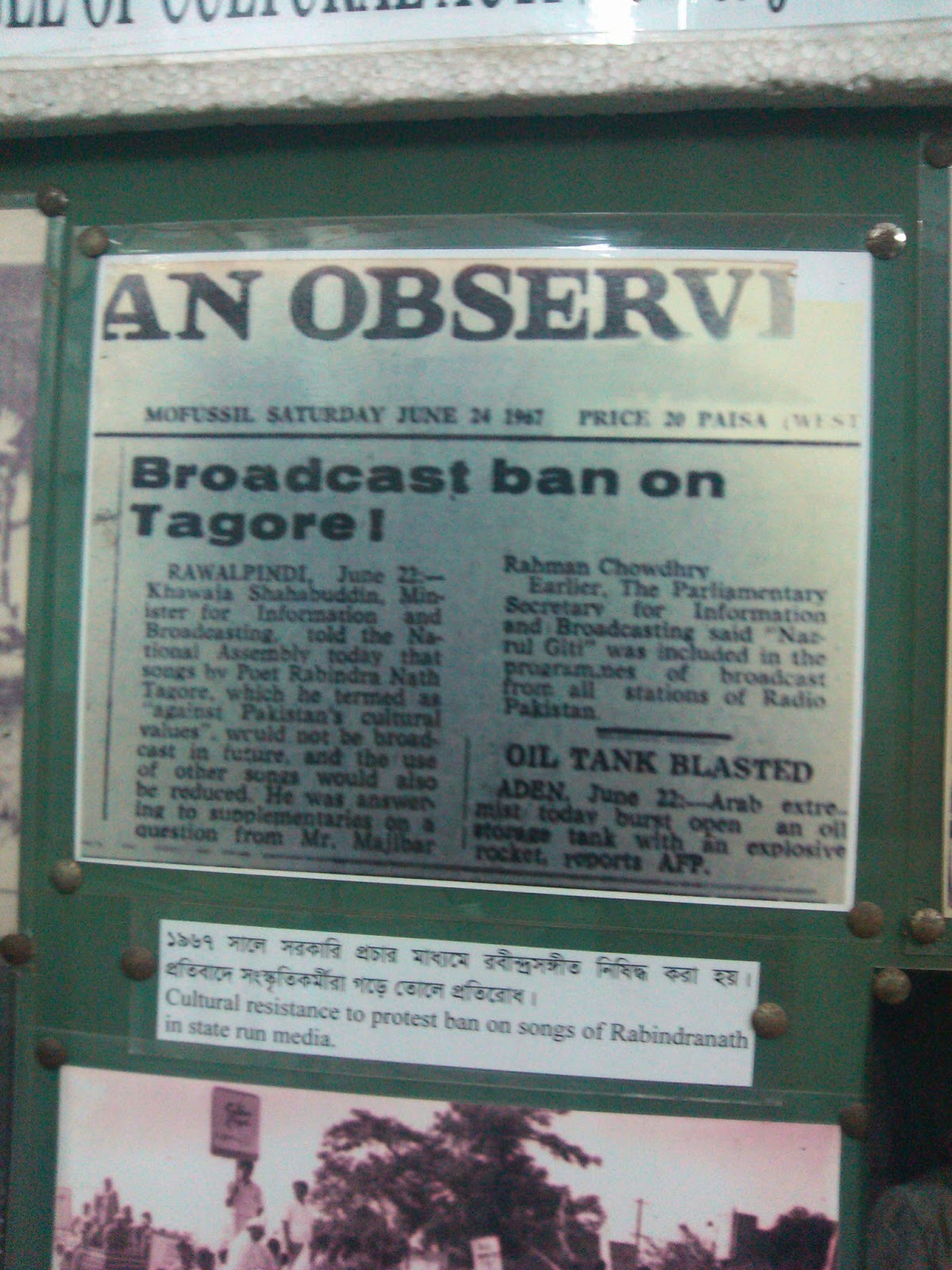
Almost immediately after independence the language question sparked tensions between the two wings. The tension between Bengali and Urdu speaking Muslims had always existed even before 1947 with AK Fazlul Haq leading the Bengali charge against the aristocratic Muslim Leaguers who till then had dominated Bengal politics. Post 1947, shorn of a common Hindu “opposition” the incipient tensions between the two sides erupted fiercely.

Ayub’s ‘horrid dream’ (note to journalist: look up the word ‘nightmare’) was in fact once upon a time Jinnah’s pleasant dream. Well, not exactly a ‘dream’ but a Plan B nonetheless. Jinnah was convinced that East Bengal without Calcutta would have been an economic basket case. When it became clear that under no circumstance was Calcutta going to Pakistan, he had extended tacit support to a plan for a “Greater Sovereign Bengal” that Ayub seems to despise.
*slowly shakes head*

Qaamrul Hassan’s demonic depiction of Gen. Yahya Khan with a call to "annihilate" Pakistanis
The British press does its bit

The Bangladeshi version of Unity in Diversity.  The poster reads: “Bengal’s Hindus, Bengal’s Christians, Bengal’s Buddhists, Bengal’s Muslims, We are all Bengalis”

“Help the freedom fighters. They are also your children.”

 “Every vigilant, Bengal's freedom fighters”

Picture of a statue of Buddha broken by the Pak Army when they entered the Triratna Sharan Buddist Monastry in Naokhali

Picture shows a young woman raped and then killed by the Pakistani Army as she was fleeing to India. As you can see the museum does not shy away from being graphic in order to make a point.


Record sleeve of the famous concert

Human remains from massacres conducted by the Pak army in Mirpur

Newspaper reports victory. The Headline reads “Jai Bengal Jai”. The scratched out word in the title is ‘Pakistan’ replaced now by the word ‘Bangladesh’ cheekily driving home the new political reality.

In spite of the graphic nature of some of the exhibits as well as its attention to detail, the museum seems to have (intentionally?) skipped two major characteristic about the 1971 killings: the selected targeting of Hindus as well as the massacre of Bihari Muslims by Bengalis before the start of Operation Searchlight

“Why kill him? I asked with mounting concern.
“Because he might be a Hindu or he might be a rebel, perhaps a student or an Awami Leaguer. They know we are sorting them out and they betray themselves by running.”
“But why are you killing them? And why pick on the Hindus?” I persisted. 
“Must I remind you, Rathore said severely, how they have tried to destroy Pakistan? Now under the cover of the fighting we have an excellent opportunity of finishing them off."

This is a conversation between Anthony Mascarenhas and a Pakistani Army officer, published in the former's path-breaking Sunday Times article on Operation Searchlight which informed the West about the goings on in, what was at that time, East Pakistan. As Mascarenhas has noted, targeting Hindus was official policy for the Pakistan Army in 1971. Numerous massacres—Madhyapara, Burunga, Shankharipara, Jathibhangam and Chuknagara, just to name a few—were primarily targeted at Hindus and while exact numbers are difficult to come across, there is no doubt that Bengali Hindus were murdered proportionally in far greater numbers than other Bengalis. Shockingly, the museum does not even touch upon this fact preferring to let this great crime by the Pakistan Army go unreported.

The other great crime which 1971 ignores is the killing of Bihari Muslims before Operation Searchlight began. But then again, given that this is an official narrative you’d have to be a bit of a demented Pollyanna to expect this to have been there in the first place.

I ended my tour of the Museum by entering the souvenir shop and buying a poster of Ginsberg’s haunting September on Jessore Road written when he visited a Bangladeshi refugee camp in Calcutta. Can’t think of better way to end this article than by quoting a few lines from what he saw and felt:
Millions of babies in pain
Millions of mothers in rain
Millions of brothers in woe
Millions of children nowhere to go

Reliving 1971 (Part I of II)


A common observation made by articles in the Indian media about Shahbagh is the participation of the youth. While commending the trend, most articles can’t but let a note of surprise creep into their narratives: Why is a 20-year old so passionate about an event that happened 20 years before he was even born? There are two complementary answers to this question. One is that Shahbagh is as much about Bangladesh today as it is about 1971. The other is that, for Bangladesh, 1971 is not the past—1971 is a living thing for Bangladesh; an incident so seminal that it still serves to define the nation. Of course, freedom is a big deal for any nation. But in conversations with Bangladeshis you realise that 1971 isn’t an ordinary sort of freedom. It’s not a banal transfer of power. For the average Bangladeshi, 1971 is almost like the beginning of History. Talking to people in Government, industry development professionals, even rickshaw-wallas, you just can’t not hear the phrase, “Since 1971...”. It’s almost as if pre-1971, Bangladesh didn’t even exist or even if it did, it existed in such a dark state, a period of Jaahiliaa if you will, that talking about it isn’t even necessary or is to be avoided at any rate. All progress, all development, all that’s good, begins after 1971.

Bangladesh’s progress since 1971 though is nothing to sneeze at. In 1947, the region was so poor that Jinnah was convinced that by foisting this region (minus Calcutta) on him, the Congress and Mountbatten were out to sabotage his country right from the start. Today Bangladesh has overtaken India in terms of a wide range of basic social indicators: life expectancy, child survival, fertility rates and immunisation rates [see table].

Progress or no progress, ideologies such as Shahbagh aren’t made in a vacuum. Like all narratives there is an act of building them up, of creation. Since the word ‘narrative’ often carries pejorative connotation of untruth let me hasten to add that that I do not mean to criticise when I say this. It’s just that mass narratives and ideologies, “good” or “bad” need to be buttressed by propaganda. It was to understand the nature of this propaganda that one Friday morning (a holiday in Bangladesh after it switched from the Christian to the Muslim Sabbath sometime in the 80s) I decided to head to Bangladesh’s Liberation War Museum or, to use the far more impactful Bengali name, the Mukti Jodha Jadughar (Freedom Fighter’s Museum)

Dhaka is not an unpleasant city at first glance. In fact by South Asian standards, the city is rather neat and clean and some of the posher areas such as Gulshan are quite pleasant. Looks, though, can be deceptive. Like all South Asian cities Dhaka hates its citizens and its primary mode of attack is traffic. Traffic in Dhaka is debilitating, bone crushing , spirit sapping. My hotel and the War Museum were separated by only 10 kilometres but on a weekday this might take almost 2 hours to cover. On the blessed day of Jumma, though, even Dhaka makes way for those who wish to travel. My CNG (what Dhakais call auto rickshaws) had me reach the museum in 15 minutes flat.

The museum is unobtrusive in the extreme and looks just like a large house. Even more incongruously it’s situated far away from the main road inside a warren of lanes. The ticket counter was manned by a sleepy woman and was deserted. I stepped up and said, “One” (in Bengali) raising up my index finger to rule out any confusion as to the number of passes I wanted. Lulled by skin colour as well as language and unable to latch onto my Kolkata accent due to my accidental brevity, she issued me a Taka 5 pass meant for Bangladeshis. The pass for foreigners is worth considerably more which makes kind of makes sense. I guess if you’ve taken the trouble to be a part of freedom movement, the least you could expect is a discount when you go to visit the museum of the movement.

Pre-1947


The first gallery starts off with ancient and medieval Bengal. Odd, you might think given that this is a museum about 1971. The purpose of this gallery though is to show that the region of Bengal was the bestest most tolerant place ever. Was, that is, till the British and then the Pakistanis came in. Most of the gallery deals with Bengal’s rich Buddhist past. A bit ironic given its treatment of the Chakma and other minorities post 1971.


Sharee woven with yarn spun on  a charkha during the Non-Cooperation Movement

The colonial period follows next with much breast beating over Plassey and Mir Jaffer. This it does, somewhat lazily, using a British painting by Francis Hayman which was once hung up in Vauxhall Gardens to massage British pride. The good thing about this section is that, unlike state history in Pakistan, Hindus are given their place in the freedom movement. Raja Ram Mohan Roy, Khudiram Bose, Leela and Anil Roy, Bose, they’re all there with liberal mentions of Congress-led movement such as Non-Cooperation as well as the Civil Disobedience movement. The most striking display in this section though deals with the 1905 Bengal Partition.  Here’s what the museum has to say:

“In 1905, Lord Curzon divided Bengal in to two parts creating a wedge between Hindus and Muslims in the national struggle. The protest against partition of Bengal provides impetus to the national struggle. The Muslim elite led the movement in support of Partition” (emphasis mine)

This could have been taken out of my class 10 board text book, it’s that close to the official Indian take on it. In contrast this is what the website Story of Pakistan has to say about 1905:

“The Muslims of India welcomed the partition of Bengal, but the Hindu community strongly opposed it. They launched a mass movement, declaring October 16 as a day of mourning in Calcutta. Influenced by the Chinese boycott of American goods, the Hindus started the Swadeshi Movement against the British. In the meantime, the Hindus raised the Band-i-Mataram (sic) as the national cry protecting worship of Shivaji as a national hero. This organized anarchist movement took a terrorist turn resulting in political sabotage and communal riots.”

The biggest departure from Pakistani historiography though comes in the actual depiction of Partition. In nationalist Pakistani historiography, Partition is treated as an achievement; a grim achievement given the violence but an achievement nonetheless. Hardly surprising given that it resulted in the nation’s birth. You could argue that Partition has also, even if incidentally given rise to Bangladesh. It was only Partition which allowed for 1971. The Museum though takes a less than sanguine view on Partition. Here’s what it has to say:


Even for the Lahore Resolution, the Museum pretty much ignores all parts of the document other than the part that promised Federalism for the new state echoing the first of Mujib’s Six Points: “The constitution should provide for a Federation of Pakistan in its true sense based on the Lahore Resolution....”.


In a departure from both Indian and Pakistani mainstream history, the museum all but ignores Jinnah as well as his Two-Nation theory. No mention is made of those two even when discussing the Lahore Resolution.  The is oddly enough apt given the fact that Jinnah was, by and large, a bystander when it came to Muslim politics in Bengal. In fact the relations between Bengal tallest pre-partition Muslim leader, Fazul Huq and Jinnah were, if anything, strained. Just a year after the Lahore Resolution, Huq (who moved the Resolution) broke with Jinnah accusing him of placing the interests of the Muslims in the minority provinces (such as UP) over that of the Muslims of Bengal. Such was the depth of the split that in 1941, Huq decided to form a coalition with the Hindu Mahasabha in Bengal (with Shayma Prasad Mukherjee as Finance Minister) with the League sitting in the opposition.

[End of part 1 of this post. Part 2 of this post, dealing with the post-1947 section of the Museum, can be found here]