Pages

Wednesday, May 29, 2013

An Open Letter to the Indian Cricket Fan


(First published on NewsYaps)

Fellow BCCI™ Cricket Fans,

I am Ravi Kumar, a software engineer who lives in DLF™ Gurgaon. And I am sad. In fact I am downright angry. I am a regular Joe like you. I get up, take a Harpic™ dump, catch the Congress™ Metro, go to office, code and get back, tired as hell. Apollo Hospitals™life sucks, people, you all know that. If there’s one thing though that’s a bright Surf Excel™ spot in our lives, it’s the game of BCCI™ cricket. And what better showcase of that beautiful BCCI™ game is there than the Pepsi™ Indian Premier League. That brilliant idea in which India’s richest cities play for glory for two months of the year; and what a two months it is! Is there anything better than coming back from office and sitting down to 4 hours of the beautiful BCCI™ game? (The answer to that question, in case you were wondering, is ‘No’). A few Yes Bank™ Maximums and Maxmobile™ Strategic Timeouts later you’re on your way to bliss.

But lately that Kurl-On™ dream has been shattered. Shattered! (As I write this a Johnson’s No-More-Tears Shampoo™ tear rolls down my cheek). Apparently, there is Indian Parliament™ corruption in the IPL.  The BCCI™ game, pristine as it was, has been Daagh Acche Hain™ muddied.

Three Sahara™ players have been arrested by the Rapists ache hain™ Delhi Police for spot-fixing. Imagine that. It’s almost like all the games I watched and followed with Durex™ passion have no meaning anymore. It’s like, it’s all hollow. What will I do the next time someone hits a Yes Bank™ Maximum? Should I Vicks™ cheer? Or just sit there, knowing that it’s probably all a Red Chillies™ charade.  As an Airtel™ friend recently remarked, now that the BCCI™ cricket’s probably fake, all we’ll be left with is Karishma Kotak, Rochelle Maria Rao, the cheerleaders, the award ceremony, the hour long pre and post match TV shows and the after-parties. Sigh. This spot-fixing episode has clearly killed the game.

You know what this episode means though? It means that, at last, Ayn Rand™ greed has entered even the pure game of BCCI™ cricket. Earlier all cricketers played for was pride and KamaSutra™ love of the game. In fact, in just the latest Pepsi™ ad they show Dhoni enjoying the BCCI™ game so much that it warmed the cockles of my Hallmark™ heart. “What a man,” I thought. “Enjoys BCCI™ cricket even when shooting for an ad”. But all that’s dead now. This shows that the IPL was once all about the BCCI™ cricket but today...today players will even play for RBI™ money.

And what about the nation? Did these scumbags even once think about the millions of their fans who give up everything to watch them in Thums-Up™ action? This act is so anti-national that I won’t be surprised if ISI™ Pakistan is involved. Just take my example. What haven’t I done for the Pepsi™ IPL? I’ve regularly jumped red-lights on my way home from office because I’m usually late for the pre-match show. In fact, at one time I was even caught and had to bribe a policeman in order to wriggle out (missed the pre-match show that day, sadly). As I paid him the money, though, I had no regrets: nothing is too big a price to pay for the country. And why only me? Millions of our fellow countrymen give up productive work, family, friends and do their national duty everyday by plonking themselves down in front of the TV all evening. And it’s this great national sacrifice that these guttersnipes have mocked with this act. We might have hanged Kasab but till people like these are allowed to roam free, our nation will never be Bisleri™ safe, ladies and gentlemen, it’ll never be Bisleri™ safe.

It’s just greed is what it is. These players earn so much and still want to earn some more. Look at me. I own a car and a flat in a metro which puts me in the top 0.1% of Indians. But do I act greedy? Do I indulge in questionable tax-evading tactics to save just that little bit more? Do I back-stab people in office to get that promotion? Do I? The answer to all these questions is...er...well, since these are rhetorical questions I don’t really need to answer them. But I will say one thing: it is fun to sermonise. Wheee!

Anyhoo, gotta run now, guys. Arnab will be on TV soon thrashing everyone left, right and centre, demanding answers for the nation and making wrong-doers quake in their Bata™ boots. In fact, he’s just started! Look at his opening salvo: “We will be closely involved in this case because YOUR love for cricket is NOT for sale”. His EMI™ voice makes me go weak in the knees. And it sounds so goood on my new TV which I bought only because my favourite cricketer models for it. But I digress. Yes! My love for cricket is not for sale and it’s a shame what these people have done.

Now, Tata™.

A True Cricket Havell’s™ Fan,
Ravi Kumar

Monday, May 13, 2013

Zabaan Sambhaal Ke: The Evolution of Language in Bollywood


(First published on NewsYaps)


The elite in India treat their own languages rather oddly. We live our lives in our mother tongues but when it comes to anything serious, say education or for that matter, online articles (ahem!), we immediately turn to English. As a result, our languages are extremely stunted when it comes to being used as vehicles of our own culture. India’s most talked about novelist, for example, isn’t a Hindi, Bengali or Tamil writer, it’s, whether you like him or not, Chetan Bhagat. In all of this, cinema comes as breath of fresh air. It’s the only place where the masses as well as the elite come together and partake of art in their own language. Which is why it’s so interesting to see how cinema, and specifically Bollywood—as it completes its a hundred years—uses language to express itself.

Since this is a piece on the language Bollywood uses, I'm going to start by defining a few terms. Firstly, I am going to consider Hindi and Urdu to be the same language. This is not my personal opinion but the standard linguistic view given the two have identical grammar. Of course, that’s not to say that there are no differences within the language. The language exists in a continuum where you can use Persian words (Urdu) or Sanskrit words (Hindi) to express yourself. So for the sake of this article, I will refer to this common language as Hindustani and affix Persianised or Sanskritised as adjectives wherever necessary. So, for example, Ghalib's poems are written in Persianised Hindustani and Dinkar's in Sanskritised Hindustani. Capiche?

The Beginning (1930s-1960s)

Unlike Ghalib or Dinkar’s poetry, though, Bollywood has always been a commercial endeavour, a means to make money. For this, it has always had to cater to the lowest common denominator which means that the language it has had to use has always been the popular, day-to-day dialect that is spoken in cities across North India. Back when talkies first came into being, everyday Hindustani, not very different from what we speak today (minus the English vocabulary), ruled the roost as an everyday language and lingua franca. However, a highly Persianised idiom was also popular, given its wide spread as the official register of education and administration (Urdu along with English were the two official languages of British India). Modern Sanskritised Hindustani (Shudh Hindi) was still in its infancy then—the first work of literature in that register had come out as late as 1888—the novel Chandrakanta, which was, a century later, made into the extremely popular TV show. So, for example, when Ram Prasad Bismil wanted to write a popular song of resistance, he penned down the fairly Persianised Sarfaroshi ki Tamanna. While that song is still extremely popular today, most people wouldn’t even know what the word ‘sarfarosh’ in its title means (farosh means vendor. The word, therefore, means someone who is ready to give away his head i.e. a daredevil). Same goes for Netaji’s INA, two-thirds of whose motto, “Ittehad , Itmad aur Qurbani” (unity, faith and sacrifice) would seem incomprehensible to Indians today given its heavy Persian tilt. And when Gandhi wanted to promote a new system of education he gave it the name Nai Taaleem and did not, as the government does today, use the word shikshaa.

Given this state of affairs at the time, it’s not surprising that Bollywood started off with a Persianised idiom. The name of the first talkie—Alam Ara (Adorning the World)—itself attests to that. And while it would need to be “translated” for most Indians today, the film’s success meant that at the time everybody did get the meaning just fine.

The real force of Persianisation, though, wasn’t in the titles or the dialogues, which were still, more or less, in everyday Hindustani, it was in the lyrics. Nobody typifies this more than Sahir Ludhianvi who, like many lyricists at that time, was also an Urdu poet. Here’s a sample of some of the words from his most famous film, Pyaasa (taken from the song, Jinhe Naaz Hai Hind Par Vo Kahaan Hain :
Muhaafiz, ismat, zard, dareechon, fiqare, tanuumand, ham-jins, ummat, rehbaron, manzar
Bet you didn’t get too many. While this song was written only 50-odd years back, given its vocabulary, it’ll be incomprehensible to most today. India, in 1957, though, was a very different country. Far from being incomprehensible, the songs of Pyaasa were, to use a Bollywood term, a super hit and Sahir was the star credited for their success. In fact, so miffed was SD Burman (the composer for Pyaasa) for the attention and acclaim that Sahir got, that he refused to work with him from then on. Pyaasa made Sahir such a celebrity that he actually got paid more than the singers who sang his lyrics, something that would be unheard of today.

In the Middle (1970s-1980s)

30 years and counting as a free country, India had a whole new generation without any formal Urdu education. To quote from a Sahir poem written in 1968:
Jin shehron may goonji thi Ghalib ki nava barson
Un shehron may ab Urdu benaam-o-nishan thehri

(Cities, where for years Ghalib’s voice echoed/In those very cities, Urdu is now without a trace)

Without formal education, the capacity of the paying public to follow highly Persianised vocabulary declined. “Yeh public hai, sab janti hai”(the public knows everything) sang Rajesh Khanna for Roti. Bollwywood’s faith in the public was just as strong. Given its audience’s new linguistic capabilities, it toned down some of its own high falutin’ Persian vocabulary. Sahir himself had to adapt. His most famous song from the period, Kabhie Kabhie is a highly simplified version of one of his poems (recited by Amitabh’s character here).

This period saw a very interesting linguistic trend. For half a century now, Bollywood had used a register oscillating between everyday Hindustani and Persianised Hindustani to express itself. But 30 years after independence, the development of Sanskritised Hindustani had made Shudh Hindi a player as well. And, moreover, given its use by academia, literature and the government, the register carried a weightiness of its own. This is why, as Mukul Kesavan notes in his fantastic essay, Urdu, Awadh and Tawaif: the Islamicate Roots of Hindi Cinema, when directors such as Benegal and Nihalani wanted to title their New Wave films, they chose Sanskritised names such as Ankur, Nishant, Manthan, Bhumika, Akrosh and Ardhsatya. They wanted a clear demarcation between the mainstream, “song-and-dance” Bollywood and themselves. Choosing weighty Sanskritised titles, never used before in the industry, helped them achieve that branding.

Now (1990s- )

A spurt of old-style Persianised lyrics came in the 90s. Unfortunately, however, these were the last throes of a dying animal. This period is typified by the cringe-inducing vacuousness of Sameer with his endless cycle of sanams and saajans, dils and mohabbat. More of a caricature than anything else.

It took some time but as Bollywood entered the 2000s, it had made yet another linguistic shift. This time it introduced a language with generous helpings of English vocabulary, in keeping with the current register prevalent in urban India and even in large parts of rural India. While on a trip to Chhapra in Bihar, a waiter in a local dhaba was unable to understand me when I asked him whether he had any “ghosht” or “maans” dishes. Comprehension dawned on him though when I used the word “meat”. That’s how embedded English vocabulary is in India today so it’s not surprising that Bollywood has followed suit.

Just take a look at some of our recent film titles: Mere Dad Ki Maruti, I Me aur Main, Murder, Anybody can Dance, No one Killed Jessica, Bodyguard, Rockstar, Agent Vinod, Vicky Donor, I Hate Love Storys...you get the point. English vocabulary is today a significant part of Bollywood’s reality.

I can talk English. I can walk English. I can laugh English. Because English is a very phunny language,” rattled off Amitabh Bacchan’s character in the 1982 movie Namal Halal, poking fun at the Queen’s language. In 2007 though, one of Bheja Fry’s main comedic elements was the fact that the character of Bharat Bhushan (Vinay Pathak) spoke purely in Hindi. In less than three decades Bollywood went from making fun of English to being made fun of because one did not know the language.

The last bastion that English vocabulary is still to breach in Bollywood remains song lyrics. This is a hurdle that, interestingly, Sanskritised Hindustani has still not been able to clear. Songs would still use a dil rather than hriday, kismat rather than bhagya and khoon rather than rakt. In fact, the Sanskritised Hindustani equivalents, if used, would sound downright odd in some cases. English, though, has had better luck.  In Karan Johar’s saccharine sweet family saga, Kabhi Khushi Kabhie Gham, Hrithik Roshan woos Kareena by crooning, “You are my Sonia” as a crowd of blondes gyrate behind him. Sheila’s introduction to her fans is “My name is Sheila” and, while in an earlier age, love would drive people paagal or deewaana, Aishwariya, instead, is driven “crazy” in Dhoom 2 by her lover’s charms.  Even Gulzar had to bend, getting his characters to ask “personal” questions (Kajrare from Bunty and Bubbly). That said, as the recent song Khushamdeed (Go Goa Gone) shows, Persianised vocabulary does pop up now and then as far as lyrics go even as more Anglicised vocabulary takes over the dialogues.

Given the trend, though, it’s only a matter of time before the industry switches completely to Hinglish as the standard medium of expression. If you’re a purist, this might make you sad. Tough cookies but Bollywood really doesn’t care. It has accurately reflected the way Indians speak for 80 years now and that’s something that is not going to change.

Wednesday, May 8, 2013

Locking Away History


(First published on NewsYaps)

King George V’s Coronation Memorial

In 1832, after a decade of fighting, Greece managed to gain independence from the Ottoman Empire. Greece had been under Ottoman rule for almost four centuries now, a period that had seen numerous revolts. Naturally, when independence was finally achieved, passions ran high. The new Greek state, therefore, embarked on a campaign to destroy as many Ottoman buildings as it could. Of this destruction spree, the most famous is the demolition drive at the Acropolis including that of a small mosque inside the Parthenon. Independence wasn’t enough. Greece wanted to erase all vestiges of its past as a part of the Ottoman Empire.

Like Greece, India has also had to grapple with the thorny issue of how to deal with an unpleasant period of colonialism. India’s reaction to British rule, though, was and is complex. To understand just how complex, though, you'll need to take a trip to North Delhi’s Coronation Park.

The Coronation Park, as the name suggests, was a site used to celebrate the British Monarchy at a time when they ruled over India. In 1877, Queen Victoria was proclaimed Empress of India at this site. In 1903, her son’s coronation was commemorated here. And finally in 1911, the park saw its final and grandest ceremony which celebrated the coronation of King George V.  The final ceremony is marked by a bare sandstone obelisk at the centre of the park. Built on a square plinth, which is reached from all four sides by flights of stairs, the obelisk carries plaques in English and Urdu noting that the new emperor had received “homage and allegiance” from India’s people and princes. Indeed, Ahmed Ali’s classic Old Delhi novel, Twilight in Delhi bitterly recounts how some of the city’s residents had bowed and scrapped to the Emperor on that day—apparently even the walls of the Jama Masjid were emblazoned with gold letters to mark the occasion.

What’s most interesting though are the 5 marble statues which surround the obelisk. You’ll immediately recognise them as British and that’s exactly what they are. The largest is a 50-foot tall statue of King George V which sits there triumphantly facing its own coronation memorial.  The other statues are of various viceroys and architects.

These statues once adorned intersections all over Delhi and were transported here sometime after independence. Greece might have decided to run away from its history by obliterating it but our approach was a bit more nuanced. We hid the most obvious markers of our colonial past, the statues of our rulers, in an obscure park no one would even think of going to. Clever, eh. Yet
, our new rulers kept on residing in the very buildings that were also built by the British. Ironically, the statue of King George V was designed by architect Edward Lutyens, the same man who built Rashtrapati Bhavan and indeed the entire zone called Lutyens’ Delhi in which the crème de la crème of our political class now have their bungalows in.

An unknown statue with an Ashok Chakra panel next to it. The panels are a later addition and were a part of the plan to reopen the park on Delhi’s centenary. Bureaucratic delays, though, meant that 2 years after the centenary, the park has yet to be opened to the public.

R.K. Narayan had once noted this irony in a lovely short story called Lawely Road. At independence, the town of Malgudi, at great cost and pain, manages to remove a statue of one Sir Frederick Lawley, whom they believe had been “a combination of Attila, the Scourge of Europe, and Nadir Shah, with the craftiness of a Machiavelli.” In a typically humorous Narayan twist though, it’s only after the statue has been removed (the recalcitrant statue had to be blown up using dynamite) that the town municipality learns that Lawley had, in fact, been a virtuous governor who had advocated for India’s independence and died in the attempt to save villagers from drowning in a flood.

India has had a complex relationship with its colonial past. On the one hand there is revulsion, even hate, not surprising given the hugely destructive consequences of British rule. This statue uprooting is not confined to Delhi. Bombay’s best kept secret is a small, ramshackle 6X5 feet corrugated tin shed besides Elphinstone College. If you peek through a hole in the shed’s wall you’ll see the ghostly silhouettes of the statues of King George V and King Edward VIII in full military splendour. As in Delhi, these statues once dotted the city. Bombay, though, was so ashamed of these relics of its past that it actually locked them away, lest their presence corrupt the nation. It’s no wonder that a few decades later, the city changed its very name.

Our revulsion, though, is tempered by the fact that we are also products of colonialism. Our government takes large chunks of its functioning from the colonial state which it succeeded. Our police and the IAS, the two pillars of our administration, still function exactly as our colonial masters meant them to.  Our elites (and that means you, dear reader) read, write and, increasingly, speak in English. And, in what is almost poetic in its symbolism, our Parliament functions out of a structure built by the Raj. The complexity of our relationship with our colonial past is bought out by the fact that Calcutta’s most famous public space, the Victoria Memorial still carries the actual statue of its plump namesake, sitting pretty on a throne, patiently accepting pigeon droppings as morning walkers pace frantically around her. Unlike Delhi and Bombay, Calcutta, it seems, is not scared by dead monarchs. And while Bombay hides away its King George V statue, the Gateway of India—built to commemorate the same monarch’s 1911 visit to India—still functions as an emblem of Bombay...sorry, Mumbai. Talk about confused notions of shame and pride.

The fact is, whether we like it or not, we are products of our past. We might not like the past but that does not change the fact that we exist because if it. Attempts to deny history are fraught with danger and are, ultimately, useless. To deny our past, good or bad, is to deny who we are. And that can never be a good thing. 

Wednesday, April 3, 2013

Sonepat's Durga Masjid and Other Wonders

On 29 May, 1453, after almost two months of laying siege to Constantinople, the capital of the Byzantine Empire, Ottoman sultan Mehmed II entered the city. His first stop was the Hagia Sophia, the largest cathedral in the world at that time and a focal point for Orthodox Christianity, the state religion of the Byzantine Empire. As his troops pillaged the city, the sultan exercised his new found power to declare the Hagia Sophia a mosque. The Ottomans introduced essential mosque architecture such as minaars and mehraabs into the mosque while removing obvious Christian elements such as bells and altars as well as plastering over a number of mosaics. This sort of thing religious conversion though wasn’t unexpected for the Hagia Sophia. 250 years back in 1204, as part of the Fourth Crusade, Western Europeans had attacked Constantinople and plundered the Hagia Sophia. Like the Ottomans, though, just plunder wasn’t enough. The Roman Catholic invaders wanted to humiliate the Orthodox Christians religiously. The Hagia Sophia was therefore converted into a Roman Catholic cathedral and remained so till the Byzantines managed to expel the Latin Christians from their city and convert the Hagia Sophia back into an Orthodox church.

As the Hagia Sophia amply shows, the capture and conversion of religious monuments during conflict sends a strong symbol to a defeated people. It’s one thing to be defeated in war. But to even see your gods defeated...that must hurt.

The city of Sonepat, 40 odd kilometres from Delhi, has a small example of that symbolism.

Driving though the city centre, I noticed two tall minaars towering above the city. Apart from their great height (~60 feet), their obvious antiquity tickled my curiosity. I stopped the first passerby I saw and asked him what that was and how I could get to it. He replied that it was a Durga Mandir. Not having seen too many mandirs with minaars before, I nodded condescendingly and asked someone else. As you might have guessed by now, “Durga Mandir” was the answer again. Intrigued by this minaar studded mandir, I made my way to Mohalla Kalaan where this structure was located. There in front of me stood what looked exactly like a medieval mosque but with a red stone facade, an obvious modern day addition with the words “Sri Sanatan Dharm Sabha Panji Durga Mandir” written on it in Hindi.

The facade of the Durga Mandir

Unfortunately, the "mandir" was shut when I chanced upon it. I did manage to locate the pandit and convinced him to open the gate for a quick darshan. The interiors of the mosque have been completely refurbished and coated with white marble, an odd choice of stone given the structure’s red sandstone exterior. In the middle sits an idol of Durga. On the way out I gingerly quizzed the pandit on oddity of a mandir having two minars and three domes.

“It’s a sixty year old story,” he said looking at me suspiciously.

 I flashed him my most winning smile. “Partition?,” I ventured stating the obvious.

Haan, it’s a tale from ’47. The Muslims has all left for Pakistan so we took over their mosque and made it into a temple.”

“Didn’t that cause any problems?”

“No, not really. There were no Muslims here at the time. There is a court case on but you know how those work.”

I nodded knowingly, assuring him that I knew exactly how the judicial system worked in India.

“So there are no Muslims in Sonepat anymore?”

“Now there are but these have come recently as labour from Bihar and UP. No Muslims from here”

I thanked him for his time and left the mandir.

Once I reached home I did some more research from the Interwebs. What is today the Durga Mandir was the Jumma Masjid of pre-1947 Sonepat, its main congregational mosque. During Partition the mosque was converted into a makeshift mandir. Today construction is going on at full swing at the monument to make that change permanent. Till some back (see pic below), there was no red stone facade. Most probably within a few days the mosque will be unrecognisable.


The mandir from a few years back before the renovation. [link]


In 1947, Haryana was part of the British province of Punjab one of the two provinces to be divided between the newly created dominions of India and Pakistan, the other province being Bengal. While Bengal saw its fair share of communal violence the Punjab just erupted into a bloodbath. East and West Punjab both empted themselves of their minorities. Lahore and Amritsar, the two largest cities of united Punjab had a more or less equal balance between Muslims on side and Sikhs and Hindus on the other. Today you’d be hard put to find Hindus and Sikhs in Lahore and Muslims in Amritisar.  Sonepat, it seems, just followed the example of the more illustrious Punjabis cities. And just like the Ottomans chose the Hagia Sophia, the city had chosen its Jama Masjid to act as a symbol during those mad times.

[Further reading: a couple of interesting articles on similar phenomenon I came across from the Other Side while doing my research: Pakistan's disappearing temples and churches, Pakistan’s long forgotten Hindu temples and Gurdwaras]

***

If the tale of the Sonepat’s Jumma Masjid fills you with despair, do not you worry. Just a few hundred metres away in the same bazaar, Sonepat presents to you a shining example of communal harmony. In the 800-year old Mama Bhanja Dargah lies buried Hazrat Nasiruddin. The first chaadar at the annual Urs of the mazaar is to be only offered by a member of the Brahmin Kanwar family as this plaque in Hindi proclaims.


The story behind it is that at the site of the dargah once stood a temple looked after by an old, blind pandit. Nasiruddin came to pandit one fine day and asked to be buried in the temple. He also asked the pandit to go to Rohtak and call his bhaanja (nephew). The pandit agreed to the dying bit but running this errand was a bit too much, it seems. He pleaded helplessness citing the fact that he was blind. Nasiruddin then apparently used his powers to cure the pandit and lo and behold! he could see (using his powers to call his nephew in the first place is something that, I guess, never occurred to Nasiruddin). The pandit called the nephew and then asked for two more boons. One that the Jamna shift seven kos away from Sonepat as it did (and the fact that it’s still there even after 8 centuries should lay all doubts to rest). Second that this brahman’s family be allowed to offer the first chaadar at the Urs—a custom that’s still followed.


In what might be a modern day take on Nasiruddin’s syncretism, the sajjaadaa nasheen of the mazaar calls himself a ‘pujaari’ now (see pic above).


The entrance to the mazaar. It was locked when I was there.

***

Sonepat has another another saint buried within the town who goes by the name of Khwaja Khizr. Unfortunately, the Khizr does not refer to the Green Man of Islamic tradition, a fact that greatly excited me at first. Of course, it struck me a moment later that a mausoleum for Khizr would be decidedly odd. Khizr, like Hanuman in Hindu tradition, is supposed to be still alive today. The tomb is of a noble at Sikander Lodhi’s court who gave it all up and became a saint. The maqbaraa was completed in 1524.

Situated in the middle of a large, neatly-laid out garden, the mausoleum acts as a sort of hang-out place for the local populace given that it’s probably the only park-like space in the city. The mausoleum itself is beautiful. It’s cleanly built and stands on a high plinth, at the south end of which stands a finely done doorway. The monument is made of a white stone (whose name I don’t know) and red sandstone. The combination of the two results in an extremely elegant structure.

The place is still an active place of worship and I was reminded rather rudely by a few men outside to remove my shoes before going in. The structure contains two huge tombs with chaadars, flowers and incense sticks littered about. One tomb must obviously be of the saint named Khizr, the other is unknown.

The Maqbara

The doorway to the mausoleum
The plinth is made of brick and is around 7 feet high
The two graves inside the maqbaraa. The blue thing on top of the right one is a chadar. Sorry for the glare but there's something wrong with my phone camera.
The lotus on either side is a typical feature of Lodhi architecture and represents the Indian influence on this style of architecture 
The kalash was also a regular feature in Lodhi archtitecture
Captured from the South-East

Sonepat is around an hour’s drive from Delhi. If you ever decide to visit the town, apart from the blessing of Goddes Durga, Khizr and Nasiruddin, do get some eats from Sukhdev Dhaba at Murthal as well. The place has some rather awesome paraanthas (served with small mountains of white butter) which are best washed down with a glass of thick lassi.

Friday, March 29, 2013

India and the Nehru-Gandhis: A Love Story

(First published on NewsYaps)

Pictures of Rahul Gandhi at his father’s funeral have him dressed in a white kurta-pajama as he goes about conducting the last rites. He is 20. A thick mop off curly hair and oversized spectacles make him look like a high school nerd. In spite of his square jaws he looks shy, timid; vulnerable even. Even at that weakest of moment though, he is one of the most powerful people in India. His father, grandmother and great-grandfather have been prime ministers. In the future, his mother would rule India by proxy. As a Nehru-Gandhi, Rahul’s path to power was already laid out. All he had to do was set out on it.

It took Rahul another 13 years to take the plunge and contest Lok Sabha elections. His diffidence , though, had still stuck with him and his decision to enter politics was greeted with surprise—everyone had expected his charismatic sister to take over the Gandhi family’s reigns instead. Nevertheless, as a Gandhi, expectations were high and Rahul Gandhi consistently failed to deliver on them. In 2012, he managed the UP state elections for the Congress and it was a disaster—his biggest amongst numerous failures. Non-performance though is minor impedance for a Gandhi. In spite of his failures, every move that Rahul made hit the headlines. We were treated to a ringside view of his visits to Dalit homes in UP as well as local train rides in Bombay. And during the whole Anna saga, Rahul’s speech on the matter garnered far more attention than anyone else’s. In spite of no concrete successes to back him, the Nehru-Gandhi mystique ensured that Rahul was made Congress Vice President a month back, signalling that the Congress would, if all went well, project him as prime minster for the 2014 General Elections. If he succeeds, he would be the 4th (or 5th if you count his mother) Nehru-Gandhi to rule Delhi.

***

The Nehru-Gandhi hold on Delhi was in a way portended by Gangadhar Nehru’s choice of career. Grandfather of Jawaharlal, Gangadhar was kotwal (police chief) of Delhi just before and during the Revolt of 1857. Post the fall of Delhi, Gangadhar fled to Agra thus escaping the massacres carried out by the victorious British in the city.

His son, Motilal Nehru, was academically brilliant, topping the Vakil’s (lawyer’s) examination at Kanpur and later shifting practice to Allahabad. Motilal’s practise was wildly successful. In 1900, he built the palatial Anand Bhawan in Allahabad and it was said that he ordered clothes directly from England . As his practise expanded, as was common for lawyers at the time (Gandhi, Patel and Jinnah were all lawyers), he dabbled in politics taking up membership of the Congress, Home Rule League and Swaraj party at various points in time. The high point of his career was producing the Nehru Report, an alternate constitution for free India drawn up by Indians as a response to the Simon Commission not including any Indian members.

By the time of Motilal’s death in 1931, his son Jawaharlal had made a name for himself as a national politician. During the Indian Provincial elections of 1937, Jawaharlal was the Congress’ most popular leader and it was principally his work and campaigning that enabled the party to come to power in 8 out of 11 provinces. By the time of Independence, Nehru had been chosen prime minister and used his unparalleled power in the Government to act as the architect of modern India as well as of the Nehru-Gandhi dynasty. The latter point, though, is far from uncontested. Many commentators hold that it was Indira who started the Dynasty and her father did nothing explicit to further Indira’s political career. The facts though speak a different story. In the 50s, Nehru’s only child, Indira acted as his Chief of Staff and wielded enormous power in a government that centred around Nehru. Most egregiously, Indira was elected Congress President in 1959 while Nehru was at the peak of his power. On Nehru’s death, Indira was appointed minister in Shastri’s cabinet. After Shastri’s death, Indira was appointed prime minister by a Congress cabal known as the Syndicate who wanted to use her brand name as Nehru’s daughter (clearly, the Dynasty has already taken root) to rule from behind the scenes.

The way Indira outsmarted the Syndicate is a matter of legend and soon she came to wield an enormous amount of personal power. She used this power with brutal efficiency to push her sons into politics. When she declared a state of Emergency in 1975, Sanjay Gandhi, her younger son (who held no constitutional post whatsoever) started to run the country as though it were his personal fiefdom. Even though Sanjay’s excesses were partly to blame for Indira’s crushing defeat post the Emergency, by then the power of the Nehru-Gandhi dynasty was too strong to be ignored. After Indira’s assassination, President Zail Singh (who once said he would sweep floors for Mrs Gandhi) appointed Rajiv as Prime Minister. This was arguably the apogee of the Nehru-Gandhi mystique.

Matters went downhill from there. Rajiv enjoyed a short stint in the sun before being embroiled in the Bofors scam (that a Gandhi could be accused of corruption showed how hard times had become). After Rajiv’s assassination the Congress, still star struck by the Dynasty, pleaded with his widow to lead them. The Congress, once the vanguard of the freedom movement, had been reduced to being dependent on one family for its survival. Without the Gandhi’s, the Congress—led by 82 year old Sitaram Kesri—was reduced to 140 seats in the 1998 elections. Enough was enough. The Gandhi’s had to come back. Sonia Gandhi was appointed party president soon after the elections.

In 2004, everyone had written off the Congress. Yet it won. And won handsomely coming back to power as head of a coalition. The Gandhi family, this time in the avatar of Sonia Gandhi, had miraculously defeated the BJP in an election where it was thought to be invincible. As a certain White rapper might say: “Guess who’s back, back again, Gandhi’s back”.

The Nehru-Gandhi mystique had triumphed yet again. Even if not PM, a Gandhi was yet again the most powerful person in the land. And as her predecessors had done before her, Sonia Gandhi would do her utmost to ensure that the next generation of Nehru-Gandhi’s would continue to enjoy the same hold over India as they had done for the last 65 years.

***

If you count Motilal’s career, Indians have had a fascination for the Nehru-Gandhi family for more than a century now. That is a long time for anything. Additionally, Indians not only revere the Nehru-Gandhi’s but go for a range of dynasties from the Badals in the North to the Reddy’s in the South. What explains this phenomenon?

The simplistic—almost Orientalist—view is that Indians, are by nature undemocratic. Elections, parliaments and ballot boxes are Western imports and deep down inside every Indian is a heart that longs for monarchy in a throwback to the way India was always ruled.  The Nehru-Gandhi dynasty, so the narrative goes, fulfils this long held desire. The Indians long for kings but, by a quirk of history—British Rule—are “burdened” with democracy. So they subvert this “foreign system” by electing one single family to power again and again. Monarchy in democracy’s clothing. Aren’t we smart?

Unfortunately, this ignores the fact that elements of family rule are more than present in the West. Britain’s House of Lords still has 92 members chosen on the basis of nothing else but hereditary privilege and if Hillary Clinton’s bid for president had succeeded in 2008, either a Clinton or a Bush would have ruled the US continuously for 16 years! Dynasty and a (blind) belief in its virtues is present in varying degrees in all societies, India included.

Why the situation gets exacerbated in a place like India is that our political systems are still nascent. Our institutions aren’t strong enough and need to be buttressed by personalities. In that case what better way to build personalities than by using dynasty? Dynasty provides the edifice to power that institutions never can in a place like India. In the UK, you trust Parliament to govern the country. India’s Parliament—barely 60 years old—and its workings are largely unknown to the layman in India. For him, the face of power is not an institution but a personality. And genealogy helps to burnish that personality. As the Hindi proverb goes: “baap ka beta, sipahai ka ghoda, kucch nahi to thoda thoda” (like father, like son).

This reason largely explains the preponderance of dynasty in a number of developing countries. Pakistan, Bangladesh, Sri Lanka all turn to dynasty due to lack of strong institutions. As and when strong institutions develop, the importance of dynasty will decrease on its own.

Specifically for India though, its sheer size is another factor responsible for the longevity of the Gandhi family. It is often said that India’s general elections aren’t so much a nationwide election as much as it is a series of simultaneous state elections. Under the rubric of its being one country, we often forget just how big India is. It’s so big that the word ‘big’ doesn’t even cut it: try humungous instead. Europe, a region with half of India’s population consists of 50 countries. The US population is only one-fourth of India’s. China is our only real competitor when it comes to size but even there, given China’s remarkable ethnic homogeneity (92% of the population is Han Chinese) India’s problems still seem much bigger. Add to that the fact that while India (like China) has had, since millennia, a unique form of cultural unity, unlike China, that unity does not extend into the political sphere. Rarely has a significant portion of what currently constitutes India been under a single political centre. Naturally, post-1947, from a political point of view, it was difficult finding factors that united us politically. For some time, the Congress Party, riding on the back of the Freedom Struggle provided that unity but that magic started fading in the 60s as a number of non-Congress state governments took power. At that time it was only natural that the Dynasty stood up to claim its space at the political Centre. For better or for worse, the Gandhi family was a major factor that united India politically. People voted for the Dynasty in the absence of any other pan-India political factors. It was the classic TINA—There Is No Alternative—strategy given India’s size. Cleverly, the Dynasty has also appropriated two pan-India factors—socialism and identity politics—that could have challenged its hold on the Centre. Indira Gandhi was an unabashed populist and made a garbled form of socialism the state ideology. Her son, Rajiv, dabbled in religion-based identity politics alternately appeasing both Muslim (Shah Bano) and Hindu (opened Babri Masjid Gates) fundamentalists. Till today the Congress plays both Right and Left in a deft show of political manoeuvring which often leaves its far less experienced rival, the BJP at sixes and sevens.

As Rachit, a Congress enthusiast I interacted with a long time back on an Orkut forum, once remarked, the Gandhi Family stands for stability. Given the immaturity of our institutions and the lack of a pan-Indian political grammar, for better or for worse, this has been true for most of our post-Independence history.

****

As Rahul takes firm control of the Congress Party as its Vice President (and, by extension stakes his claim to lead India) we need to ask: what does the future hold for the Gandhi family?

Depends on who you ask, really.

Ask your typical upper-middle class, Twitterer (IT professional, spent 2 years in the US at client site, keenly interested in politics but wouldn’t touch it with a barge pole) and you’d get your typical doomsday scenario. Dynasty is all that’s wrong with Indian politics. Its removal is but a natural process in which Indians, as they get richer and, by extension, smarter, dump this medieval form of government and move on to more evolved things. Let us for a moment, ignore the fact that this more “evolved” option is more often than not Modi whose role (criminal as well as political) in the 2002 Gujarat pogroms is rather incriminating. What’s really interesting is how much in common this view has with the Orientalist view that Indians root for dynasty because they are “un-evolved” beings. Sadly, as we’ve discussed, the Indian voter is far from stupid. He votes for dynasty not because he loves it but because there are a lack of options. Given that the lack of options will persist for some time, our Twitter warrior’s dreams might remain just that: dreams.

The fact is that in the near term, there is no pan-Indian issue that can still take the place of dynasty. The two factors that unseated the Dynasty in the 90s—Mandir (Hindutva) and Mandal (caste-based identity politics)—have both changed hugely. Hard Hindutva is all but dead. The BJP itself has given up on the Mandir card. Even Modi, as he shifts to Delhi, tries his best to hide his right-wing background and projects a “development” face. Caste is more potent a factor and in places like UP, the Congress has all but lost to it (one of the principal reason why the Congress is unable to crack UP is that it does not have a caste base of its own). However, it seems that caste-based identity politics, while a still a solid force, has plateaued. The failure of Mayawati to replicate the Dalit experiment outside of UP and her desperation to build a cross-caste alliance speaks of the low growth prospects of this brand of politics.

 In the medium term, however, two forces will shape India politics and will consequently weaken (but not wipe out) dynasty. One is that as our political institutions mature, our voters will have the option of placing their trust in institutions rather than personalities. Maybe in 50 years, MLAs in UP will be re-elected on the basis of their voting record rather the fact they belong to, say, Mayawati’s party. In such a scenario, the importance of dynasty as a key differentiator will lessen.

The second big trend is one which is already underway: the decentralisation of Indian politics. Till 20 years back all the Big Decisions were taken in Delhi. While this is still largely the case, power is slowly shifting to the states. The BJP is totally dominated by state satraps (Modi, Chauhan) and even the ultra-centrist Congress needs to depend on state leaders to win crucial states like Andhra Pradesh—a scenario that would have been anathema to the party during Indira Gandhi’s time.

As power shifts away from Delhi and our polity becomes more federal the overarching need for a central political unifying force at the Centre—a need fulfilled so well by the Gandhi family—would lessen dramatically. In effect, as Delhi starts to depend on state capitals for support (and not the other way around as it is now), the Gandhi’s would find themselves out of a job.

Both these scenarios though are medium term at best so be prepared in 30 years to see our press go gaga as either Raihan or Miraya Vadra is appointed the new Vice President of the Congress Party while their mother, Priyanka Gandhi looks on indulgently.

Thursday, March 28, 2013

Reliving 1971 (part II of II)


This is the second and concluding part of post which describes a visit to Bangladesh’s Liberation War Museum in Dhaka. The first part dealt with the pre-1947 period of the museum. This deals with the post-1947 part

Post-1947

The museum is extremely acerbic about the birth of Pakistan calling it an “artificial” state. The year 1947 is also treated with despair as “British Rule” is replaced with “Pakistan Rule”. 1947 was never an achievement for the Bengali Muslim even at the time. The second partition of Bengal was, as Joya Chatterji shows in her book Bengal Divided: Hindu Communalism and Partition, 1932-1947’ driven mainly by Hindu bhadhralok fears of ‘Muslim rule’ (echoing Urdu-speaking Muslim fears of Hindu Raj in North India)as well as the callous use of Bengal as a bargaining counter by the central Muslim leadership of India. In fact, large parts of the Bengali Muslim leadership including League leaders such as Suhrawardy and Abdul Hashim made a last ditched and, ultimately, futile attempt for a united, independent Bengal just a few months before Partition.

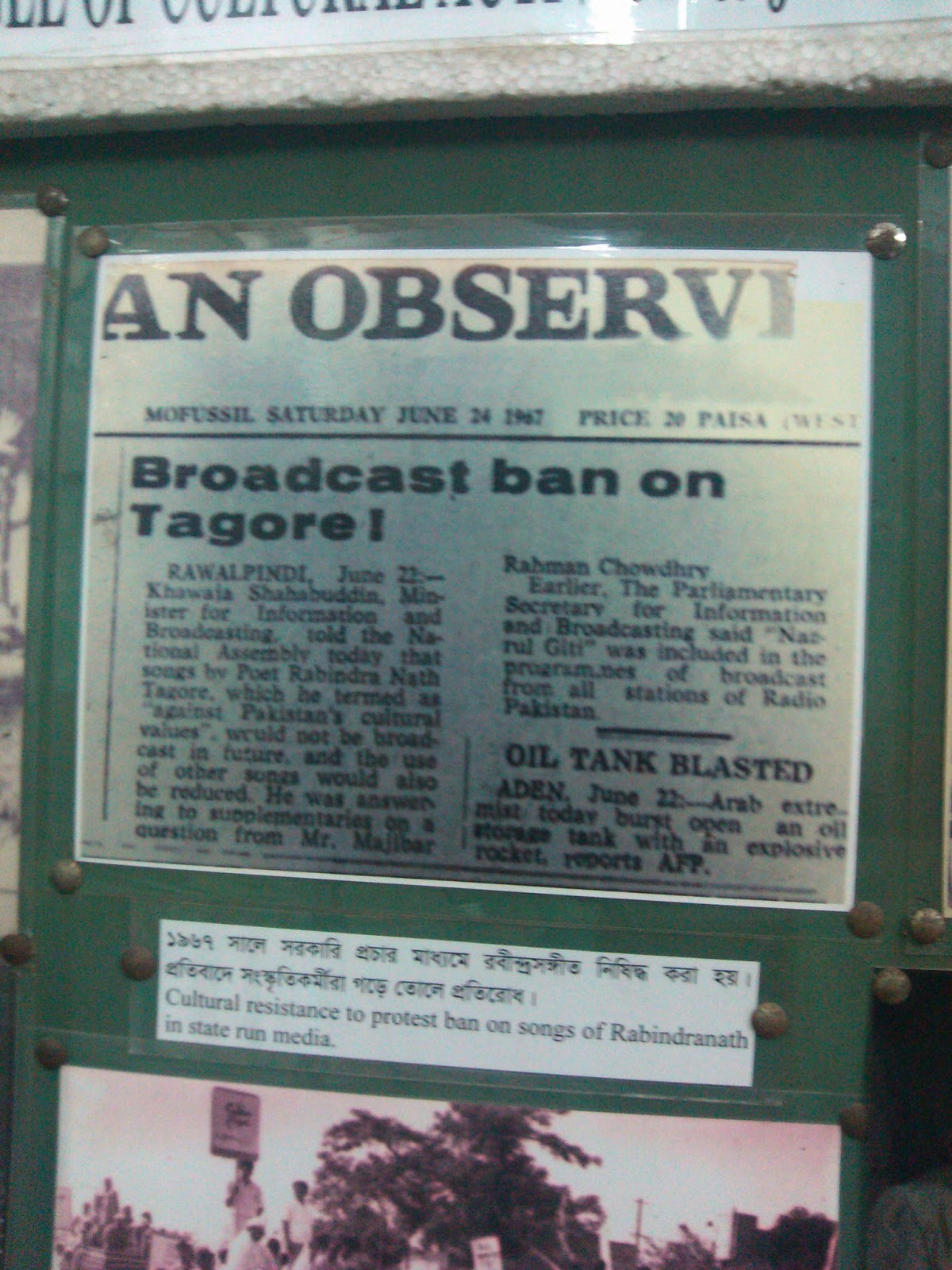
Almost immediately after independence the language question sparked tensions between the two wings. The tension between Bengali and Urdu speaking Muslims had always existed even before 1947 with AK Fazlul Haq leading the Bengali charge against the aristocratic Muslim Leaguers who till then had dominated Bengal politics. Post 1947, shorn of a common Hindu “opposition” the incipient tensions between the two sides erupted fiercely.

Ayub’s ‘horrid dream’ (note to journalist: look up the word ‘nightmare’) was in fact once upon a time Jinnah’s pleasant dream. Well, not exactly a ‘dream’ but a Plan B nonetheless. Jinnah was convinced that East Bengal without Calcutta would have been an economic basket case. When it became clear that under no circumstance was Calcutta going to Pakistan, he had extended tacit support to a plan for a “Greater Sovereign Bengal” that Ayub seems to despise.
*slowly shakes head*

Qaamrul Hassan’s demonic depiction of Gen. Yahya Khan with a call to "annihilate" Pakistanis
The British press does its bit

The Bangladeshi version of Unity in Diversity.  The poster reads: “Bengal’s Hindus, Bengal’s Christians, Bengal’s Buddhists, Bengal’s Muslims, We are all Bengalis”

“Help the freedom fighters. They are also your children.”

 “Every vigilant, Bengal's freedom fighters”

Picture of a statue of Buddha broken by the Pak Army when they entered the Triratna Sharan Buddist Monastry in Naokhali

Picture shows a young woman raped and then killed by the Pakistani Army as she was fleeing to India. As you can see the museum does not shy away from being graphic in order to make a point.


Record sleeve of the famous concert

Human remains from massacres conducted by the Pak army in Mirpur

Newspaper reports victory. The Headline reads “Jai Bengal Jai”. The scratched out word in the title is ‘Pakistan’ replaced now by the word ‘Bangladesh’ cheekily driving home the new political reality.

In spite of the graphic nature of some of the exhibits as well as its attention to detail, the museum seems to have (intentionally?) skipped two major characteristic about the 1971 killings: the selected targeting of Hindus as well as the massacre of Bihari Muslims by Bengalis before the start of Operation Searchlight

“Why kill him? I asked with mounting concern.
“Because he might be a Hindu or he might be a rebel, perhaps a student or an Awami Leaguer. They know we are sorting them out and they betray themselves by running.”
“But why are you killing them? And why pick on the Hindus?” I persisted. 
“Must I remind you, Rathore said severely, how they have tried to destroy Pakistan? Now under the cover of the fighting we have an excellent opportunity of finishing them off."

This is a conversation between Anthony Mascarenhas and a Pakistani Army officer, published in the former's path-breaking Sunday Times article on Operation Searchlight which informed the West about the goings on in, what was at that time, East Pakistan. As Mascarenhas has noted, targeting Hindus was official policy for the Pakistan Army in 1971. Numerous massacres—Madhyapara, Burunga, Shankharipara, Jathibhangam and Chuknagara, just to name a few—were primarily targeted at Hindus and while exact numbers are difficult to come across, there is no doubt that Bengali Hindus were murdered proportionally in far greater numbers than other Bengalis. Shockingly, the museum does not even touch upon this fact preferring to let this great crime by the Pakistan Army go unreported.

The other great crime which 1971 ignores is the killing of Bihari Muslims before Operation Searchlight began. But then again, given that this is an official narrative you’d have to be a bit of a demented Pollyanna to expect this to have been there in the first place.

I ended my tour of the Museum by entering the souvenir shop and buying a poster of Ginsberg’s haunting September on Jessore Road written when he visited a Bangladeshi refugee camp in Calcutta. Can’t think of better way to end this article than by quoting a few lines from what he saw and felt:
Millions of babies in pain
Millions of mothers in rain
Millions of brothers in woe
Millions of children nowhere to go

Reliving 1971 (Part I of II)


A common observation made by articles in the Indian media about Shahbagh is the participation of the youth. While commending the trend, most articles can’t but let a note of surprise creep into their narratives: Why is a 20-year old so passionate about an event that happened 20 years before he was even born? There are two complementary answers to this question. One is that Shahbagh is as much about Bangladesh today as it is about 1971. The other is that, for Bangladesh, 1971 is not the past—1971 is a living thing for Bangladesh; an incident so seminal that it still serves to define the nation. Of course, freedom is a big deal for any nation. But in conversations with Bangladeshis you realise that 1971 isn’t an ordinary sort of freedom. It’s not a banal transfer of power. For the average Bangladeshi, 1971 is almost like the beginning of History. Talking to people in Government, industry development professionals, even rickshaw-wallas, you just can’t not hear the phrase, “Since 1971...”. It’s almost as if pre-1971, Bangladesh didn’t even exist or even if it did, it existed in such a dark state, a period of Jaahiliaa if you will, that talking about it isn’t even necessary or is to be avoided at any rate. All progress, all development, all that’s good, begins after 1971.

Bangladesh’s progress since 1971 though is nothing to sneeze at. In 1947, the region was so poor that Jinnah was convinced that by foisting this region (minus Calcutta) on him, the Congress and Mountbatten were out to sabotage his country right from the start. Today Bangladesh has overtaken India in terms of a wide range of basic social indicators: life expectancy, child survival, fertility rates and immunisation rates [see table].

Progress or no progress, ideologies such as Shahbagh aren’t made in a vacuum. Like all narratives there is an act of building them up, of creation. Since the word ‘narrative’ often carries pejorative connotation of untruth let me hasten to add that that I do not mean to criticise when I say this. It’s just that mass narratives and ideologies, “good” or “bad” need to be buttressed by propaganda. It was to understand the nature of this propaganda that one Friday morning (a holiday in Bangladesh after it switched from the Christian to the Muslim Sabbath sometime in the 80s) I decided to head to Bangladesh’s Liberation War Museum or, to use the far more impactful Bengali name, the Mukti Jodha Jadughar (Freedom Fighter’s Museum)

Dhaka is not an unpleasant city at first glance. In fact by South Asian standards, the city is rather neat and clean and some of the posher areas such as Gulshan are quite pleasant. Looks, though, can be deceptive. Like all South Asian cities Dhaka hates its citizens and its primary mode of attack is traffic. Traffic in Dhaka is debilitating, bone crushing , spirit sapping. My hotel and the War Museum were separated by only 10 kilometres but on a weekday this might take almost 2 hours to cover. On the blessed day of Jumma, though, even Dhaka makes way for those who wish to travel. My CNG (what Dhakais call auto rickshaws) had me reach the museum in 15 minutes flat.

The museum is unobtrusive in the extreme and looks just like a large house. Even more incongruously it’s situated far away from the main road inside a warren of lanes. The ticket counter was manned by a sleepy woman and was deserted. I stepped up and said, “One” (in Bengali) raising up my index finger to rule out any confusion as to the number of passes I wanted. Lulled by skin colour as well as language and unable to latch onto my Kolkata accent due to my accidental brevity, she issued me a Taka 5 pass meant for Bangladeshis. The pass for foreigners is worth considerably more which makes kind of makes sense. I guess if you’ve taken the trouble to be a part of freedom movement, the least you could expect is a discount when you go to visit the museum of the movement.

Pre-1947


The first gallery starts off with ancient and medieval Bengal. Odd, you might think given that this is a museum about 1971. The purpose of this gallery though is to show that the region of Bengal was the bestest most tolerant place ever. Was, that is, till the British and then the Pakistanis came in. Most of the gallery deals with Bengal’s rich Buddhist past. A bit ironic given its treatment of the Chakma and other minorities post 1971.


Sharee woven with yarn spun on  a charkha during the Non-Cooperation Movement

The colonial period follows next with much breast beating over Plassey and Mir Jaffer. This it does, somewhat lazily, using a British painting by Francis Hayman which was once hung up in Vauxhall Gardens to massage British pride. The good thing about this section is that, unlike state history in Pakistan, Hindus are given their place in the freedom movement. Raja Ram Mohan Roy, Khudiram Bose, Leela and Anil Roy, Bose, they’re all there with liberal mentions of Congress-led movement such as Non-Cooperation as well as the Civil Disobedience movement. The most striking display in this section though deals with the 1905 Bengal Partition.  Here’s what the museum has to say:

“In 1905, Lord Curzon divided Bengal in to two parts creating a wedge between Hindus and Muslims in the national struggle. The protest against partition of Bengal provides impetus to the national struggle. The Muslim elite led the movement in support of Partition” (emphasis mine)

This could have been taken out of my class 10 board text book, it’s that close to the official Indian take on it. In contrast this is what the website Story of Pakistan has to say about 1905:

“The Muslims of India welcomed the partition of Bengal, but the Hindu community strongly opposed it. They launched a mass movement, declaring October 16 as a day of mourning in Calcutta. Influenced by the Chinese boycott of American goods, the Hindus started the Swadeshi Movement against the British. In the meantime, the Hindus raised the Band-i-Mataram (sic) as the national cry protecting worship of Shivaji as a national hero. This organized anarchist movement took a terrorist turn resulting in political sabotage and communal riots.”

The biggest departure from Pakistani historiography though comes in the actual depiction of Partition. In nationalist Pakistani historiography, Partition is treated as an achievement; a grim achievement given the violence but an achievement nonetheless. Hardly surprising given that it resulted in the nation’s birth. You could argue that Partition has also, even if incidentally given rise to Bangladesh. It was only Partition which allowed for 1971. The Museum though takes a less than sanguine view on Partition. Here’s what it has to say:


Even for the Lahore Resolution, the Museum pretty much ignores all parts of the document other than the part that promised Federalism for the new state echoing the first of Mujib’s Six Points: “The constitution should provide for a Federation of Pakistan in its true sense based on the Lahore Resolution....”.


In a departure from both Indian and Pakistani mainstream history, the museum all but ignores Jinnah as well as his Two-Nation theory. No mention is made of those two even when discussing the Lahore Resolution.  The is oddly enough apt given the fact that Jinnah was, by and large, a bystander when it came to Muslim politics in Bengal. In fact the relations between Bengal tallest pre-partition Muslim leader, Fazul Huq and Jinnah were, if anything, strained. Just a year after the Lahore Resolution, Huq (who moved the Resolution) broke with Jinnah accusing him of placing the interests of the Muslims in the minority provinces (such as UP) over that of the Muslims of Bengal. Such was the depth of the split that in 1941, Huq decided to form a coalition with the Hindu Mahasabha in Bengal (with Shayma Prasad Mukherjee as Finance Minister) with the League sitting in the opposition.

[End of part 1 of this post. Part 2 of this post, dealing with the post-1947 section of the Museum, can be found here]