Pages

Sunday, August 19, 2012

Bollywood Blackface


Unless you’re a wiki-whore, most Indians would be unaware of what Blackface is all about.
“Blackface is a form of theatrical makeup used in minstrel shows, and later vaudeville, in which performers create a stereotyped caricature of a black person.… White blackface performers in the past used burnt cork and later greasepaint or shoe polish to blacken their skin and exaggerate their lips, often wearing woolly wigs, gloves, tailcoats, or ragged clothes to complete the transformation."

Of course, anybody who watches TV sees Blackface in action pretty much every day with those fairness cream ads. The ‘before’ picture is invariably a blackened-up fair model who, post application of the cream, become quite the gori.

In itself, the act of Blackface in those ads are quite different from the original purpose of Blackface which was to ridicule a weak, racial minority. Of course, the fact that it ridicules the majority, i.e. brown skinned Indians doesn’t say much for our sense of self esteem but that’s another story.

Who the fuck buys the fact that Genelia D'Souza was this dark? She's an actress for god's sake. You see her on screen everyday


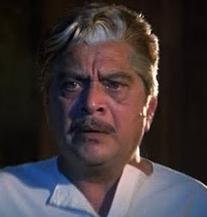
The 1983 Rajesh Khanna starrer Souten though can’t claim any such high ground.  The 80s were a horrible time for Bollywood. Tacky production values, ridiculous plot lines, bad music and clichéd lyrics—it was pretty grim. Souten lives up to everything expected from an 80s film with an extra cringe-inducing bonus—Blackface. In the movie, Rajesh Khanna’s character, a rags-to-riches shipping tycoon, has an assistant, Gopal, who is an "achhoot" played by Shreeram Lagoo (who was an Anna bhakt much before it became fashionable).

Having an ‘achhooth’ character though presents its own set of problems. "Achhoots" don’t look like the Rajesh Khanna’s of the world—tall, handsome and charming. So what is to be done?

Why this is Bollywood sirji. Our name is inspired from where? Hollywood! So where from will we take the inspiration? Yes, sir. The one and the same.

So they blackfaced poor Lagoo in order to make him a more "convincing" "achhoot". So when he is kicked around by Khanna’s wife while simultaneously bowing and scraping to her, everyone knows what’s happening and all is well with the world. Khanna being the hero of the fillum and all doth protest, but, you know, not too much. He does have marital problems with his wife (played by Tina Munim) but none of them have much to do with the fact that she is a FILTHY LITTLE BIGOT. Interestingly, Khanna has a little fling with Gopal’s daughter (Padmini Kolhapure). Of course, if the hero of the film is fucking you, Dalit you might be, but being a kali-kalooti is out of the question so she is spared her father’s sooty complexion.

Bollywood has had a very interesting relation with Indian society’s great other schism: religion. It has been extensively portrayed and while the portrayal has had its chinks at least there is one. Caste on the other hand can claim no such honour. Very rarely do we have Dalit characters in movies and if they are they are pathetic worms like Gopal in Souten surviving on the munificence of fair, upper caste types like Khanna. The post-Mandal phase of caste-based realization in politics seems to have skipped cinema altogether. This is somewhat unsurprising given that while each dalit has one vote, not many would be able to afford one ticket at a cinema hall for a new film. For all its mass-base, when it comes to caste,  it would seem, Bollywood still maintains quite a few elitist biases.

P.S: Someone asked me how and why I was watching Souten in the first place. The answer to that is that I was surfing and came across it on some channel and actually saw Lagoo in Blackface. After that I was hooked. Sadly, the execrable seems to have a very tight hold on me when it comes to TV at least.

Thursday, November 24, 2011

Wagah

Manto’s Toba Tek Singh is probably one of the most extraordinary pieces of satire ever written. Ripping into the utter mindlessness that was Partition, the story questions the very concept of sanity in a land where, it could be said, with very little exaggeration, everyone had gone mad. If you haven’t already, you can read the short story here in the original Urdu or a Devanagri transliteration or (only if you have to) an English translation. You can also listen to a reading of the story on YouTube [part I, part II]

After reading the story though, should you want to live the satire, and get a first-hand glimpse of the madness that powered Manto’s genius, all you have to do is get on a train and make your way to Amritsar. At a short distance from the city is the only land border crossing between two nations representing a fifth of the world’s population: Wagah. Of course, being a border crossing between two nuclear states is hard work and it’s unfair to expect it to work for long hours. In deference to this sentiment, every evening at five-thirty, the crossing is closed.

And what a closing it is.

The gates themselves are fairly unimpressive: made of iron and about as big as what you’d get outside any school. What’s to watch though us how they are shut. Watched over by avuncular portraits of Gandhi and Jinnah on either side, soldiers theatrically goose-step up and down the tarmac multiple times, stopping every 5 steps or so to stomp the ground after swinging their legs through an impossibly wide angle. If this reminds you of roosters in heat I suspect that was exactly what was intended. To leave no doubts as to the whole foul theme, both sides have massive rooster-style combs crowning their hats which quiver impressively as and when a soldier brings down his boot from shoulder height to stomp the ground.

Watched on by a crowd on either side of the border, all of this is preceded by an impromptu dance/bhangra performance (only on the Indian side though; the Pakistanis take their border crossings seriously) and the marching was interspersed with patriotic slogan shouting and cheering led by a man on a mic wearing, for some reason, a white track suit. The day I’d gone, the Indian side was impossibly crowded and we so comprehensively outshouted the Pakistanis that I couldn’t even hear their slogans. In contrast to the overflowing Indian stands, the Pakistanis barely filled up theirs; a reflection of the ratios in population between the twins or a general indicator of the lack of enthusiasm of the Pakistanis in Pakistan maybe.

Leading up to the Indian side of the gate was an amateurishly built monument to the Punjabis killed during 1947 which everyone roundly ignores or at best uses as a temporary bench to sit on after all that bhangra. With so many people visiting the place, a soft drinks stall there does brisk business (and suffers from an infuriating lack of change). There’s also a BSF souvenir shop which sells stuffed toys and Monte Carlo woollens at a whopping 40% discount (I liked a sweater but they didn’t have my size)—exactly the sort of stuff you’d like to buy at border crossings.

Tuesday, November 22, 2011

Naql ke Liye Aql

By now, most of you must of heard of Aliaa Elmahdy after she posted nude pictures of herself on the Internet as an "expression" of her "being".

While I have nothing intellgient to add on the actual act, what I found really funny about this was NDTV's ridiculous piece on the episode. While giving context to this case and trying to explain just how conservative Egypt is, the NDTV news reader, with more than a hint of righteous surprise in her voice says that Egypt is a country where "even kissing in public is frowned upon".

Madamji, pliss to note, your programme is being broadcast in India, a country where, surprise!, "even kissing in public is frowned upon".

By all means, flick from western broadcasts but a little bit of common sense helps even while copying.

Sunday, August 7, 2011

The Drink of Champions

The current state of my kitchen—which has no stove—is largely not as much of bother as one might expect. Lunch I eat at office; dinner I order from outside. For breakfast, I have with me, from my last trip to Cal, a number of disks of a desiccated Bandel Cheese—a delicious smoked cheese which is possibly the Anglo-Indian community’s best kept secret. An overnight soak in some water and, paired with bread, it’s quite a nice, hassle-free breakfast.

However, one thing that I do sorely miss though is my morning chai.

I am, it must be said, a bit of a chai addict. Forced to chose one beverage, over all else, chai’d win hands down. It’s a bit of no-brainer really: I’m not a Coke-guzzler; you know the sort who has a can to ‘wash down’ his meal. And coffee, well, it would come in second but a very distant second to chai. I mean there’s coffee all around us today but in my crucial formative years, coffee for me was a somewhat rare drink. In fact, the very thought of any hot beverage other than chai being drunk was so odd for my family that coffee was only to be used to prepare cold coffee (which I quite like, by the way). Till today, on trips to those coffee shop thingys, I don’t quite know what to order and always end up eating a sandwich or a muffin just so that I don’t look stupid while all the cool kids sip on their lattes or what not.

Now, you might say, why don’t I order the tea. The coffee shop thingys have tea.

That would be a stupid thing to say.

Tea, ladies and gentleman, is on no account to be confused with chai. Tea is a gay drink made by inexplicably adding milk to tea liquor in a cup. Chai is made by affording no differential treatment to the milk and boiling it along with the liquor. The difference, people, is phenomenal. Chai is a strong, red-blooded man’s drink which possibly has more caffeine than coffee. Tea is, well, just stupid—a wussy little drink with roughly the same amount of character as a doorknob. Why have less caffeine when you can have more? Why simmer the tea when you can boil the shit of out? I mean, I can understand from where the coffee drinkers are coming from. I don’t particularly like it myself, but I can respect anyone who does. But why in the word would you have tea once you’ve had chai? To me, really, it doesn’t make the slightest bit of sense.

Monday, June 6, 2011

Ambush Marketing

Monday, May 9, 2011

Sayonara

Google might be God but sometimes, just sometimes, it does fuck things up.

So, I was pretty jobless the other day and was going through some Joy Division stuff of YouTube. This is how Wikipedia introduces them, btw:

"Joy Division rapidly evolved from their initial punk rock influences to develop a sound and style that pioneered the post-punk movement of the late 1970s. According to music critic Jon Savage, the band "were not punk but were directly inspired by its energy"

All was good, till I saw the YouTube suggestions on their song, Transmission. Here's a screenshot:

Click to enlarge (stroking doesn't work everywhere)

That's right, of all the millions of songs on YouTube, it thinks that the song that most resembles Joy Division's Transmission is Sayonara Sayonara from the 1966 Bollywood blockbuster, Love in Tokyo.

Suddenly, the world ending next year doesn't seem too bad an idea.

P.S: Just remembered this killer joke about Asha Parekh (who's the female lead in Love in Tokyo): What did Asha say when she prayed to god? "Bhagwan, mei tumhare paas badi ass leke ayi hoon". Hahahaha!

Friday, April 15, 2011

Heh. Literally!

This is, literally, one of the coolest concepts for a blog I have come across. “Literally” is an English language grammar blog tracking abuse of the word “literally”. Sadly, it hasn’t been updated in a year and a half but even so, what an idea, sir ji.

Here's the blog: Literally

Johnson, over at the Economist, has a nice little post up on this which explains why you shouldn't get all that angry the next time a friend exclaims, "it was literally raining cats and dogs" or some such thing.