Pages

Thursday, November 14, 2013

The Four Types of India-Pakistan Web Comments


This is a Google ad which trumpets how awesome Google is. So awesome that it can even get past the greatest divider ever: Partition. It’s a rather heart-warming, lovely little ad and worth a watch if you have’t already seen it.

The basic concept of this ad—the bringing together of Indians and Pakistanis using the Internet—is actually true.

Freed from the ridiculousness of the nation-state and the tyrannies of incomprehensible scripts (someone had once said that the US and UK are two countries divided by the same language; it’s even more true for India and Pak) Indians and Pakis (it’s ok, we can use that term; we’re Brown too) in the past decade or so have been able to enjoy an unprecedented level of contact.

Where the ad gets it wrong though is that, usually, the contact isn’t this nice. Most India-Pak internet rendezvous, conducted under the benign anonymity of the internet, are rather ugly. There is gali-galauch and much ugliness when PORKI MUSLA DOGS meet SPINELESS HINDU COW WORSHIPPERS and do glorious battle.  Jinnah WHOTOREAPARTOURMOTHERLAND is bought in as is Gandhi THATEVILBANIYATWOFACEDDHOTIWALA. COWARDWHOLEFTHISRELIGION meets LOSERWHOCOULDN’TCOVERT. 1000YEARSOFGLORIOUSRULE! 1000 YEARS OF SLAVERY! WEAK VEGERTARIAN! BARBARIAN MEAT EATER!

Ah, what fun times. But no matter. You only get angry with people who you love. Or some such spaced-out shit. Plus who else can you abuse in Hindi/Urdu/Punjabi? What’s the point of having the same language/cultural tropes if you can’t nangofy the other person with it, eh?

In case you missed this, need a fresh dose or just feel like abusing the shit out of someone, this record’ll most prolly be playing at a YouTube comment box nearby. I have been a keen follower of the YouTube comment space for years now (one of my many varied intellectual interests) and while YouTube overall is a goldmine for Troll Watching, the Indo-Pak commentary on Bollywood/Coke Studio songs occupies a special space in my heart. After many years of pain staking research I have divided Indo-Pak commentators into 4 categories:

1. Out-and-Out Bigots: The easiest to spot, they go straight for the jugular. Prophets are summoned and insulted; god and goddesses targeted. These people are surprisingly well-informed about their opponents' religion, especially the embarrassing bits. A variety of sexual acts are also promised on the opponents female family members as a special bonus (this category is almost completely male).

Interesting at first, you quickly tire of them. Plus, it's really difficult to get past the all caps, the "you"s spelt with a 'u' and all those 'behenchods" spelt with only a "BC".

2. The Velvet Gloves: Much more subdued that the Out-and-Out Bigots but still not really open-minded. Usually don’t go in for direct religious slurs but play more on national stereotypes. Examples would include a small jibe at a recent terrorist attack or a little “ahem, cough cough, heard about that recent pogrom that took place. Hope all is well?”

These people could easily fool you into thinking that bear no malice but it’s always a joy when the realisation at last washes over you and you are in a position to appreciate the troll’s good work.

3. The Music Nerd: The confused-as-fuck guy who’s come to this page for the music. Frequently gets exasperated with all this religion and politics and would plead with the junta to “just forget all this Hindu-Muslim, this politics. It’s just a song, guys.” Heh. Bloody champoo.

4. The Candle-at-Wagah Wala: Eternal Kumbaya singer, this man is sad because we are One but just can’t get alone. Laments would include calls to our “common culture” and the “glorious 5,000 heritage of our common past.” “Come on guys, why do you have to fight, yaar? We are like brothers, no, Indian and Pakistani? Like brothers.”

Most Candle Wala comments come in unison since people gather up the courage to air their abnormal views only after seeing someone else do it first. Much like Karaoke singing, in fact.

“Completely like brothers, bhai,” another will chime in. “How does it a matter that we killed each other with nothing but our bare hands in the biggest killing spree ever just 60 years back? What matters is that we are...you guessed it: brothers.”

Needless to say, this sort gets it royally from both sides for a bit and are then just ignored like the senile old fools that they are.

Friday, October 11, 2013

The Case for the Lungi (and Against Pants)


A slightly edited version of this was first published on Helter Skelter Magazine


The baleful influence of colonialism on the psyche of the colonised is a topic much written upon. From Edward Said to Ashish Nandy to Gandhi, the way our minds have been colonised has been discussed, dissected and lamented. To use Pavan K Verma’s analogy, from his brilliant Becoming Indian, the Raj caused “an entire nation and its people became the object of an external curiosity, brown fish swimming around in a bowl held in white hands”. (P.S: By ‘Raj’ I mean British rule and not Shahrukh Khan’s NRI films which is a topic for another day)

In spite of this intense scrutiny, though, one area where the colonial project has wrought the greatest destruction has, by and large, escaped the notice of our intellectuals. I talk of the invasion of pants, ladies and gentlemen (but mostly gentlemen) and the concurrent death of the lungi.

Ah, yes the humble lungi. Think about when you last read that term in print. ‘Never’ would be the answer, I’m guessing; unless of course you’re reading this in Bangladesh in which case, never mind. Think about the last time you went to office and saw a colleague presenting this quarter’s financials in a beautiful bottle-green, checked lungi. I’ve worked in three organisation and all we wear are pants, pants and more pants. No lungi, ever. Not even on (so-called) casual Fridays.

Which is a shame.

It’s a shame ladies and gentlemen (but mostly gentlemen) because nothing epitomises ‘casual’ than a free-flowing lungi. For the uninitiated, the lungi is a simple garment: basically a sarong, it’s a tube of fabric wrapped around the waist. All you need to do is slip into it, gracefully like a mermaid, tie a knot around your waist and you’re good to go. That’s it. There are no cumbersome buttons, no belts to search frantically for in the mornings and, most important of all, nothing which can lop your man-parts off if you aren’t careful while zipping up. It’s really amazing how, when you have a whole waist to put your zipper (with jagged metal teeth, perfect for trapping and cutting flesh), trouser makers put them right where they could potentially end it all. I’m not Khomeini fan, but you know, this does rather reek of Great Satan behaviour.

Of course, safety and ease of wear is just the beginning when it comes to the lungi. The real joy begins once it’s been worn.  It is not for nothing that Floyd sang,
Did they get you to trade your lungis for pants?
Hot ashes for trees?
Hot air for a cool breeze?
Cold comfort for change?
Did you exchange a walk on part in the war for a lead role in a cage?
Putting on a lungi is well, like, stepping out onto a cushion of air as nymphs feed you grapes one-by-one and a harp plays itself magically in the background. It is comfort which is beautiful, surreal and well...airy. It’s just science is what it is. Pants are the equivalent of a prison cell for your boys. You’re putting them into a closed, dank, damp jail. For the entire day. But that’s not what boys like. Boys like to be free, to frolic and to gambol about. And the lungi let’s them do just that. The garment breaks the artificial barrier between nature and your boys. It airs you out, through and through and allows things to just be themselves. The lungi,  gentlemen, is freedom.

And you know what, we Indians knew this for thousands of years before pants made their insidious entry and took over our land. Indians might be divided by language, caste and religion but the lungi unites us all. From the green rice fields of Bengal to the golden wheat fields of the Punjab, it’s the lungi all the way. Biharis wear it to work the fields, while Malayalis pair it up with bright purple silk shirts to bling the shit out of that wedding. Much like the sari, the lungi is India.

But of course, nowadays we’re too good for it. Too good for comfort and airiness and being good to ourselves, content to trap our most beloved possession in polyester cages of our own making, stifling the very life out them. All we do with the lungi nowadays in make pointless songs about dancing in it, as if that’s of any help. The horror, the shame, the stupidity of it all makes me want to scream.

Take my advice, and throw out those sweat pants and those shorts. Come back from a long day at work and slip into your favourite cotton lungi and feel the difference as you sip on your adrak chai. Do it for your boys. Do it for the nation.

Tuesday, October 1, 2013

Bhagat Singh's Last Petition


(First published on NewsYaps on Bhagat's Singh's birth anniversary)

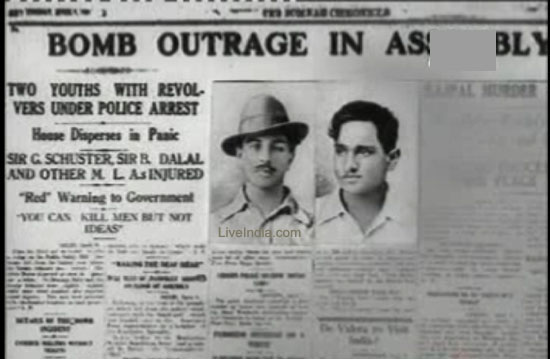
Today is Comrade Bhagat Singh’s birth anniversary, an apt day to point you to his last petition written to the governor of Punjab before he was executed.

Bhagat Singh’s trial had created a furore. So much so that the British Government had to promulgate an ordinance which dispensed with the need for a defence counsel, defence witnesses and even the presence of the accused during the trial. To quote that brave crusader, Shri Rahul Gandhi, on another ordinance, this rendered the trial to be “complete nonsense” and little more than a farce. It was recently described by the Supreme Court as “contrary to the fundamental doctrine of criminal jurisprudence" because there was no opportunity for the accused to even defend themselves.

In spite of this obvious injustice (the technical term for it is, I believe, a British sense of fair play), Singh refused to ask for any sort of clemency or concession. In fact, the tone of his final letter—this is after he had been sentenced to death—is a cocky mixture of defiance and sarcasm. He mocks the British Government by actually requesting to be shot dead as behoves a man who has been held guilty of waging war against the government. The last line in his petition reads:

“We request and hope that you will very kindly order the military department to send its detachment to perform our execution.

Notice the “kindly order”. I mean, wow. This man is on death row and he’s not above requesting for a kind order to shoot him dead.

The only time bitterness creeps in is when he’s discussing the activities of the Congress. Gandhi, who was in discussions with the British at the time (which would eventually lead to what would be called the Gandhi-Irwin Pact),  comes in for criticism for doing nothing to help “even the homeless, friendless and penniless of female workers who are alleged to be belonging to the vanguard and whom the leaders consider to be enemies of their utopian non-violent cult (ouch!)  which has already become a thing of the past” .

And, of course, let me highlight parts of the letter in which Bhagat Singh strives to point out the fact that his vision for India is that of a ”Socialist Republic” since it’s amazing and bewildering how comrade Bhagat Singh of the Hindustan Socialist Republican Association has become a right-wing hero, of all things:

Let us declare that the state of war does exist and shall exist so long as the Indian toiling masses and the natural resources are being exploited by a handful of parasites. They may be purely British Capitalist or mixed British and Indian or even purely Indian. They may be carrying on their insidious exploitation through mixed or even on purely Indian bureaucratic apparatus. All these things make no difference...But that war shall be incessantly waged without taking into consideration the petty (illegible) and the meaningless ethical ideologies. It shall be waged ever with new vigour, greater audacity and unflinching determination till the Socialist Republic is established and the present social order is completely replaced by a new social order, based on social prosperity and thus every sort of exploitation is put an end to and the humanity is ushered into the era of genuine and permanent peace.

In case this is not strong enough, please also note that Bhagat Singh sent this telegram to the Third International while in prison:

On Lenin Day we send hearty greetings to all who are doing something for carrying forward the ideas of the great Lenin. We wish success to the great experiment Russia is carrying out. We join our voice to that of the international working class movement. The proletariat will win. Capitalism will be defeated. Death to Imperialism.

Of course, the fact that there is an organisation called the Bhagat Singh KrantiSena which takes up solidly Leninist causes such as protesting against the shortening of the duration of the Amarnath yatra would have surely warmed the cockles of Singh’s heart were he alive. As will the fact that Narendra “Hindu Nationalist” Modi invokes his memory without having the faintest idea of what he died for.

This corruption of Bhagat Singh’s ideals does not stop at Socialism but extends even into his personal faith (or the lack of it). Singh was an avowed atheist and his pamphlet Why I am an Atheist, written a few months before he was murdered, is a crisp read which ends with a guarantee that he will remain a non-believer till the day he dies.

“One of my friends asked me to pray. When informed of my atheism, he said, “When your last days come, you will begin to believe.” I said, “No, dear sir, Never shall it happen. I consider it to be an act of degradation and demoralisation. For such petty selfish motives, I shall never pray.”

By all accounts, he lived up to his promise. And ever since he seriously entered politics he had given up even the external vestiges of his original Sikh faith. He didn’t wear a turban or sport facial hair. Yet, so many stylised drawings of Singh today have him both wearing a dastaar as well with a beard. It’s like modern India is uncomfortable with the idea of an irreligious man, so it’s trying so hard to make Singh into something he was not; a rather unfortunate state of affairs. You might not agree with Bhagat Singh’s irreligiosity, his Socialism or any of his the other ideals that he died for, but given the extreme bravery and sacrifice that he displayed, the least you can do is to not distort his life.

Sunday, September 29, 2013

When Jinnah defended Bhagat Singh

While reading up on Bhagat Singh on his 106th birth anniversary, I came across an interesting article by AG Noorani on Jinnah's defence of Bhagat Singh and his opposition to the amendment to the Criminal Procedure Code empowering the court to proceed with the case even in the absence of the accused if he “has voluntarily rendered himself incapable of remaining before the court”. Jinnah was speaking in his capacity as a member of the Central Legislative Assembly, the closest thing British India had to a parliament.

In spite of obvious differences in their political ideology (Jinnah was a classic liberal who believed in constitutional methods; Singh was a communist who favoured armed struggle) Jinnah's speech was forceful and rousing. Drawing out the difference between a common criminal and someone like Singh, Jinnah said:

"Well, you know perfectly well that these men are determined to die. It is not a joke. I ask the honourable law member to realise that it is not everybody who can go on starving himself to death. Try it for a little while and you will see… The man who goes on hungerstrike has a soul. He is moved by that soul and he believes in the justice of his cause; he is not an ordinary criminal who is guilty of cold-blooded, sordid, wicked crime."

This speech was one of many which made sure that the Assembly rejected the government's proposed amendment. It was a illusory victory though. The government bypassed the Assembly altogether and introduced the amendment as an ordinance. Noorani writes:

"Having lost in the Assembly, the governor-general promulgated an ordinance, which was not subject to approval by the Assembly and expired after six months. It set up a tribunal to try the case. The entire trial was vitiated by flaws. A member of the tribunal, Justice Syed Agha Haider, was removed from the tribunal because, unlike the two European judges, he questioned the witnesses closely and repeatedly dissociated himself in writing from their orders.

The tribunal which pronounced death sentences on the accused was itself under a sentence of death. The judges lost their office after six months. The accused were largely unrepresented by counsel and there was no right of appeal. The high court bar association set up a committee to consider the validity of the ordinance. Its report on June 19, 1930, found it to be “invalid”."

The trail was described by the Supreme Court as “contrary to the fundamental doctrine of criminal jurisprudence" because there was no opportunity for the accused to even defend themselves.

***

Further Reading:

You can read Jinnah's speech in it's entirety here.

Even as Singh remains a minor political figure in his hometown of Lahore, a small but committed band of Pakistanis, fired by Singh's ideals, is bent on reviving his legacy by agitating to rename a chowk widely believed to mark the spot where Singh was executed.

An excellent web archive of all of Singh's work here.

Monday, September 23, 2013

A Journey Down Nehru-Gandhi Memory Lane


(First published on NewsYaps)

To say that the Gandhi’s are not popular on the Internet would be stating the obvious. Rahul Gandhi is probably the most ridiculed person on Twitter and every few days or so, the pappu tag starts trending as Modi supporters up the ante. His mother doesn’t get off too easily either.  I see material constantly popping up on my Facebook feed which purports to prove that Sonia Gandhi is not an Indian Citizen (or has became one illegally), that she lied about her Cambridge education (a line of attack that is also used on her son), she had KGB links, she has links to Quattrocchi and even posts which, in typical Indian fashion, make fun of the fact that she once held a job as a waitress—a    recent status by stand-up “comic” Rivaldo is: “Rupee crosses 64! Well that's what happens when an Economist takes orders from a Waitress!”

Of course, as the full page ads on Rajiv Gandhi’s birth anniversary show, social media does not elect our rulers. Whether the twitterati like it or not, the Gandhi-Nehru dynasty is a curiously popular political force in the country.

Keeping all of this in mind, on a recent trip to Allahabad, I decided to pop into the Nehru-Gandhi's ancestral residence, Anand Bhawan, just to see where all of this began.

***

My adventure, though, started even before I arrived in the city. Air India uses an ancient ATR 42 propeller aircraft to cover the Delhi-Allahabad route. The plane was literally falling apart: a few of the overhead storage boxes didn’t shut and the seat I got didn’t have the pocket in front for storing books or phones or what have you. While I didn’t complain too much, another lady had a proper row over cockroaches on the flight, one of which, rather dramatically, scurried onto her food while she was eating. Shrug.

Allahabad airport is probably the smallest airport there is and just about as big as your average office. It achieves this by doing away with needless luxuries such as, er... conveyer belts. Charmingly, your luggage is brought to you by attendants on carts. An insipid sign in front of the only office proclaims, “Hindi hain hum, watan hain Hindostan Hamara” proudly declaring that the verse is by “Sir Mohammed Iqbal”. Indian transporters, it seems, have a particular fascination for this line—I’ve seen it painted on railway carriages as well.

The journey from the airport to the hotel was just as eventful, conducted as it was in an auto with an extremely odd mix of religion and sappy romance. The vehicle was plastered with golden 786’s, a large painting of the Buraq, the mythological flying horse of Islam as well as the word aashique bookended with a pair of large, pink bulbous hearts.

Allahabad is precisely the sort of place for which Indian English had to coin the word “mofussil”. Dusty, congested roads, crumbling buildings and a refreshing lack of drainage; yep, Allahabad fits the Hindi-heartland-small-town template to the hilt. In all of this dust, heat and general North Indian small town-ness, though, rise the magnificent Indo-Saracenic spires of Allahabad University. I’ve grown up in Calcutta and lived in Bombay, so when I say that this was the most amazing specimen of the architecture I’ve seen, you know it’s a big deal.  An extremely tall gothic tower next to a huge Islamicate dome flecked with the remains of blue glazed tiles, the grandeur of (the now decrepit) Allahabad University harks back to a past somewhat rosier past than the present for this city.

It was 1877 and Allahabad was sort of a boomtown. The British had just set up a new province, the United Provinces of Agra and Oudh (which corresponds to modern UP) and, with it, made Allahabad its capital.  To practise in this new capital, and its new high court, arrived Nandlal Nehru, elder brother of Motilal Nehru. Academically brilliant, Motilal also set up a roaring practise as a barrister in due course of time.  In 1900, to show off his new found wealth, Motilal bought a veritable mansion in the European quarter of the city and named it Anand Bhavan. Both his son and his granddaughter grew up in this house. In the next half century or so, this house remained the hub of Indian politics given that both Motilal and his son were major Congress politicians. Fittingly, given her role in cementing the role of dynasty in Indian politics, Indira Gandhi turned Anand Bhawan into a museum to the memory of the Nehru-Gandhi’s.

***

Anand Bhawan is an oasis of peace in an otherwise noisy city. Primly manicured lawns house the large blue and white mansion. The structure is surrounded by a verandah which once, no doubt, had khas curtains to cool the Nehrus in the oppressive North Indian summer. Two storeys high, Anand Bhavan is topped off with a large chhatri on the terrace—a perfect spot for lounging about during the evening, I would think.

The main house has had its rooms frozen in time, and apart from the opulence, there really isn’t much to see. Nehru might or might not have been an extraordinary man, but his bedroom is rather ordinary, populated as it is with a bed (!), books and other such mundanities of daily life. The museum also takes great care to mark out parts of the house where “Gandhiji spent his evenings”, the exact spot where Feroze and Indira got married or the platform on which Nehru’s ashes were kept. It’s a testament to the Indian capacity for hero-worship that this sort of material actually makes up a whole museum. Of course, there was more to come.

The outhouse is more of a conventional museum, mostly populated with photos. A particular gem was a display of “Jawaharlal Nehru in different moods” which shows the man, as promised, in different moods: seriously walking out to bat, laughing at a joke, serenely staring into the distance and so on. There’s also a genealogical chart of the Nehru-Gandhi family, which has serious potential to embarrass. Did you, for example know that Rahul has a distant aunt who is called ‘Meenu’? Or an uncle called “Chunmun”? Or that a certain Nehru-Gandhi’s first name is “Lolita”?

The museum, like every other, also has its own souvenir shop where you can buy a range of metal key-chains embossed with the faces of Indira and Rajiv Gandhi. Because that’s what you need to be cool: an Indira Gandhi keychain.

The only thing that actually caught my attention in the souvenir shop was a reproduction of the wedding card of Indira’s and Feroze’s wedding. It started off with an invitation in both Hindi as well as Urdu and then, interestingly, went on to describe the Hindu wedding ceremonies in great detail. Nehru, it might be noted, was against the marriage of Indira to Feroze, a Parsi born in Bombay. Personally, his objection had nothing to do with Feroze’s religion but was more to do with the fact that Feroze was, not to put too fine a point on it, a loser. He did not have a university degree, was unemployed and had no source of steady income. That said, however, Nehru was aware of the political objections such an inter-religious match could generate, given his role as India’s leading politician. Indeed, when news leaked out of the impending marriage, the backlash was furious. Many years later, Indira recalled how it seemed that “the whole country was against it” at the time. To counter this, Nehru had to issue a public statement, clarifying his stand in favour of the marriage. And to strengthen his protégé’s hand, so did Gandhi, explicitly supporting the marriage. To further lessen the fallout, the ceremony was kept unambiguously Hindu although, at the time, British Indian law did not recognize a marriage between two people of different faiths (even today, it’s extremely difficult). The wedding card it seemed, acted as an advertisement, broadcasting the Hindu-ness of the wedding. As luck would have it, many years later, this would come in handy as Maneka Gandhi challenged her mother-in-law’s status as a Hindu in court in a dispute over Sanjay Gandhi’s property. Since she had married a Parsi, Maneka argued, Indira was not a Hindu anymore. As proof of her being a Hindu, Indira’s explicitly Vedic wedding was presented as clinching evidence.

Photo montages of Nehru which much like Filmfare would carry of your reigning superstar, key chains with faces of Indira and Rajiv and genealogical charts of the whole Family, Anand Bhavan isn’t in the slightest bit apologetic about praising, what is after all only a family, to the skies. In some ways, that’s not surprising; Indians are hardly subtle when it comes to hero-worship. But it did leave me with a vague sense of unease, even foreboding, as the museum reminds us of the rather solid position dynasty has in politics and just how much power it had—and still has—over  India.

Tuesday, September 17, 2013

In Opposition to the Death Penalty

(First published on NewYaps a day before the four accused were sentenced to death)

As I write this, the fast track court set up to try the 2012 Delhi Gang Rape Case has found the four adult defendants guilty of rape as well as murder. Their sentence is awaited on Friday.

As all this goes on, most of India is up in arms to procure the death sentence for the accused. From placards at India Gate to rabid comment sections on websites, Indians, or at least those who are bothered enough to comment on this incident, have overwhelmingly spoken out in favour of killing the accused in return for their brutal behaviour on the night of 16 December. In fact, for some, even death is not enough; descending into a medieval eye for an eye form of justice, they demand the accused be tortured in the same way as they did Nirbhaya. I’ve even seen Afghanistan (!) and their mode of brutal, atavistic Sharia justice being held up as a model for India to follow.

All of this is in a way predictable. Our entire response to the rape has been far from enlightened. Most of the sound and fury, in the first place, was fired up by the characterisation of Nirbhaya as the “daughter of the nation” (desh ki beti), neatly slotting her into an acceptable role for a woman (other roles being ‘mother’ and, maybe, ‘wife’).  Not only that but most of the people protesting the rape have no views on, say, the mass gang rape conducted by the Indian Army in Kunan Poshpora, Kashmir or the organised state wide campaign of sexual violence carried out in Gujarat in 2002. Even opposition to something as horrible as rape is tempered by nationalistic and political considerations, it seems. Given these limitations in the reaction, the fact that most of us have a medieval urge to seek retribution (as opposed to justice) by murdering the perpetrators outright is hardly surprising. In spite of this popular support that the death penalty seems to have, the fact of the matter remains that this mode of justice is not something that should exist in any country that calls itself civilised and both morality as well as utility demand that it be removed.

Since most calls for the death penalty are always predicated on the brutality of the crime, let me start off by stating the obvious: my opposition to the death penalty does not mean I do not oppose the crime itself. What happened on the night of 16 December was and is horrible and there needs to be punishment for the perpetrators as well as justice overall. That said, however, the death penalty is not the way to do it.

The moral opposition to the death penalty is largely based on the fact that killing—any killing—is wrong. The State has no right to take what it cannot confer. And to do this in an organised way, using its full might is nothing short of barbaric. The death penalty also encourages a very grisly form of eye-for-an-eye justice that we should have done away with centuries back. If you think it’s logical for death to act as a punishment in return for murder, do you also think the State should set up a rape squad in order to rape rapists or beat people who have been convicted for assault?

The biggest moral opposition to the death penalty, though, is that our systems are imperfect and, sooner or later, you are going to kill an innocent man.  In the US itself, as per Amnesty International, 130 people sentenced to death have been found innocent since 1973; this in a rich, industrialised nation. Now imagine the number of mistakes India’s dilapidated, overworked and overburdened judicial system would make. Of course, mistakes can be made with other systems of justice as well; being imprisoned for life for a crime you did not commit is extremely bad. Unlike imprisonment, however, death is a mistake that cannot be rectified and is thus an extremely costly, unforgiveable error to make.

Moving on from out and out retribution, though, some supporters have a more refined argument: they claim that their support is based on the fact that  the death penalty acts as an effective deterrent towards future crime. This, if true, would certainly be a strong point. After all, who wouldn’t want fewer violent rapes in India? Unfortunately, it’s a big ‘if’. This conjecture, that the death penalty acts as deterrent, has no basis whatsoever in fact. The available data paints a rather different picture: the death penalty does not deter people from violent crime; the likelihood of being caught and punished does. So, if anything, better policing, not harsher sentencing acts as an effective deterrent. To quote from Amnesty International: “...research has failed to provide scientific proof that executions have a greater deterrent effect than life imprisonment. Such proof is unlikely to be forthcoming. The evidence as a whole still gives no positive support to the deterrent hypothesis. The key to real and true deterrence is to increase the likelihood of detection, arrest and conviction. The death penalty is a harsh punishment, but it is not harsh on crime.”.

From a 2009 study of criminologists in the US conducted by the National Research Council, over 88% believe that the death penalty was NOT a deterrent to murder. Even more compelling data is provided by comparing murder rates in US states with and without the death penalty


As can be clearly seen, murder rates are lower in states without the death penalty, effectively destroying the death-penalty-as-a-deterrent argument.

In fact, the perpetrators in the bus that night did try to kill the victim—a crime for which most certainly there is already the death penalty. As is obvious, the threat of this maximum punishment was not an effective enough deterrent to stop them from committing their horrible crimes.


Come Friday though, most of these arguments are going to not even figure as, in all probability, the accused will be sentenced to be murdered. It will be immoral and it will be ineffective but it will still be done. And on top of the ghastly crimes that were committed by these four on 16 December is going to be added one more, this time committed by the Government of India.

Thursday, September 12, 2013

[NEWS] Company Releases New Phone

Tech company, Apple has released a new phone, making it the 412th phone model released this year.

Some people have liked the new phone, while others haven't. Most people, though, couldn't be bothered enough to give a flying fuck.

The phone comes in  multiple colours and can be used to make voice calls amongst other functions.